Five Specialist Agents: How Each Vuln Class Gets Its Own Reasoning Pipeline
Pentestas Team
Security Analyst
Introduction to Specialized Reasoning Pipelines
At Pentestas, our approach to vulnerability detection is centered on the development of specialized reasoning pipelines tailored to distinct vulnerability classes. By differentiating these classes, we can engineer detection algorithms optimized for each type of threat. This method not only enhances our detection capabilities but also allows for the application of domain-specific logic and heuristics. For example, while an SQL Injection vulnerability demands a deep understanding of database query patterns, Cross-Site Scripting (XSS) requires an entirely different approach focused on client-side scripting and DOM manipulation.
Tailoring our reasoning pipelines for different vulnerability classes is crucial in maintaining high standards of accuracy and speed. With specialized pipelines, we can leverage the specific characteristics of each vulnerability type to minimize false positives and negatives. This specialization is akin to having distinct experts working in tandem, each focusing on their area of proficiency. This not only streamlines the detection process but also significantly reduces the time taken to identify potential threats, thus improving the overall efficiency of our security suite.
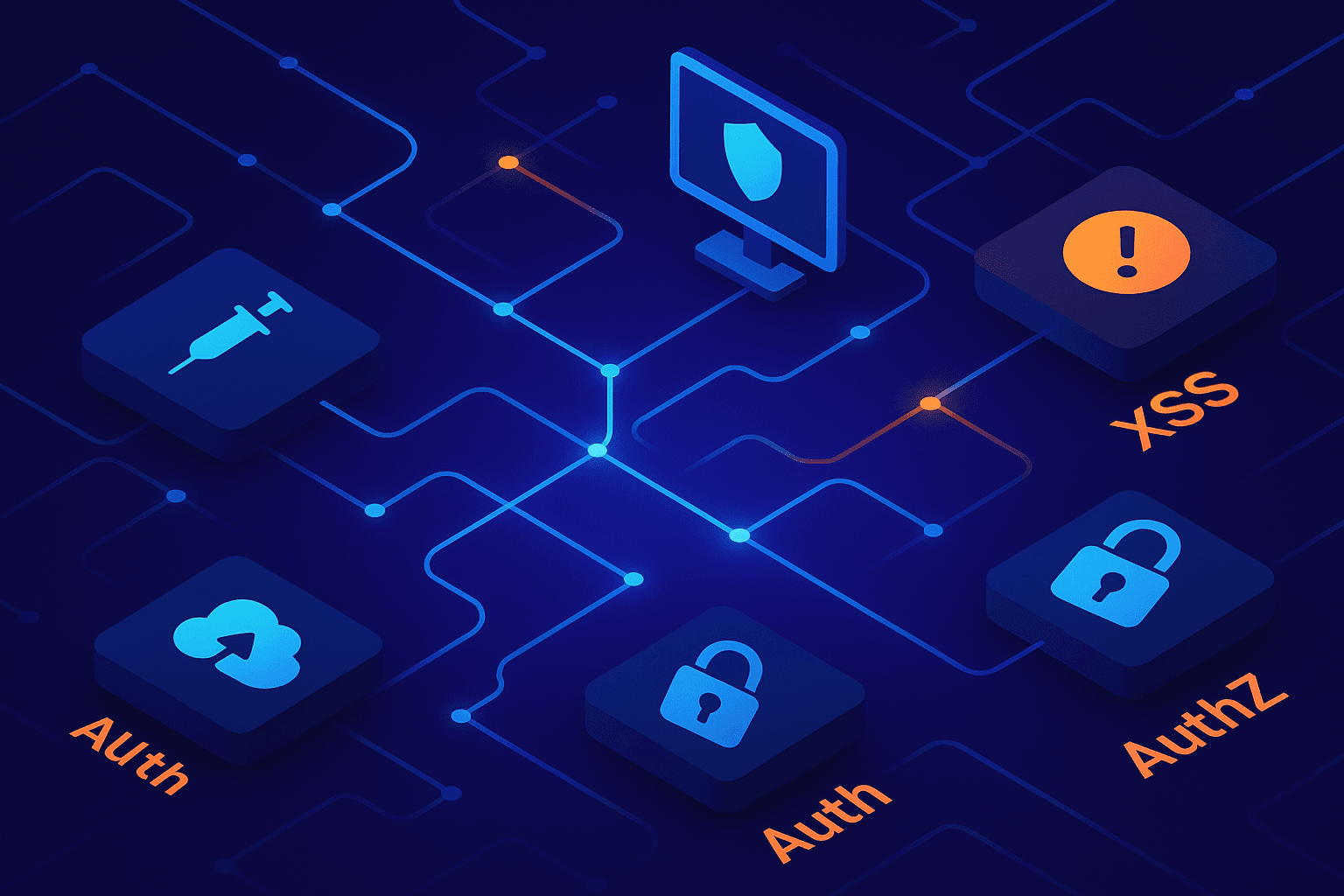
Our commitment to specialization extends across five major vulnerability classes: Injection, Cross-Site Scripting (XSS), Server-Side Request Forgery (SSRF), Authentication (Auth), and Authorization (AuthZ). Each of these classes presents unique challenges and attack vectors. For instance, SSRF might exploit a server's ability to make HTTP requests, while Authentication vulnerabilities focus on bypassing login mechanisms. Understanding these nuances allows us to fine-tune our pipelines to address the specific needs of each class, thereby enhancing our platform's overall robustness.
The Five Pillars of Vulnerability Detection
By categorizing threats into Injection, XSS, SSRF, Auth, and AuthZ, Pentestas can deploy tailored reasoning pipelines that enhance detection accuracy while reducing processing time. Each class receives dedicated attention, ensuring that our platform remains vigilant and responsive to the latest security challenges.
Injection Vulnerabilities: Tailored Detection Strategies
Injection vulnerabilities, including SQL injection, command injection, and others, present a complex landscape due to their ability to exploit various input channels and execution contexts. At Pentestas, we understand the intricacies of these vulnerabilities and have developed specialized reasoning pipelines to address them. Our detection strategy involves analyzing how untrusted inputs can manipulate the behavior of a program, often leading to unauthorized data access or execution of arbitrary commands. The complexity is further compounded by the need to consider different programming languages and frameworks, each with its own nuances.
To enhance our detection capabilities, we utilize custom prompts tailored specifically for injection vulnerabilities. These prompts guide our reasoning agents in identifying potential injection points within the codebase. For example, when examining a PHP application, we might use prompts like $query = "SELECT * FROM users WHERE id = " . $_GET['id']; to trigger a deeper analysis of how inputs are handled. By leveraging domain-specific language constructs, our agents can better map out potential vulnerabilities and suggest appropriate mitigations.
An essential component of our approach is the use of hypothesis caps, which help refine results by setting boundaries on what the reasoning agents consider plausible. For instance, when analyzing a Java application, a hypothesis cap might limit the scope to only those input points that interact with the java.sql package. This targeted focus allows us to reduce false positives and concentrate on the most likely injection vectors. Additionally, our agents require specific oracles for verification, such as database logs or command execution traces, to confirm the presence and impact of an injection vulnerability.
String query = "SELECT * FROM accounts WHERE username = '" + userInput + "' AND password = '" + password + "';";
Statement stmt = connection.createStatement();
ResultSet rs = stmt.executeQuery(query);
XSS Vulnerabilities: Specialized Reasoning Mechanisms
Detecting Cross-Site Scripting (XSS) vulnerabilities presents unique challenges due to the variety of contexts in which user input can be executed as code. These vulnerabilities arise when untrusted input is dynamically included in HTML output, leading to potential script execution. The difficulty lies in accurately identifying all possible injection points without triggering false positives, especially when considering complex web applications with rich client-side logic. Our approach involves rigorous parsing of HTML and JavaScript to identify potential entry points where XSS could manifest.
To enhance detection accuracy, we design unique prompts specifically tailored for XSS identification. These prompts guide our agents in examining DOM structures and JavaScript execution paths. For instance, prompts might include explicit instructions to trace data from source to sink, ensuring that user inputs are sanitized before being integrated into the DOM. This tailored prompting leads to a significant improvement in identifying true vulnerabilities without overwhelming developers with false alarms.
function sanitizeInput(input) {
    const tagBody = '(?:[^\"><]+|<\/\w+>)*';
    const tagOrComment = new RegExp(
        '<!--(?:-*[^\->])*-->|' + // HTML comments
        '<\/?\w+(?:\s+\w+(?:\s*=\s*(?:"[^"]*"|\'[^\']*\'|[^\s"\'>]*))?)*\s*\/?>', 'g'
    );
    let oldHtml;
    do {
        oldHtml = input;
        input = input.replace(tagOrComment, '');
    } while (input !== oldHtml);
    return input.replace(/
To further refine our detection process, we implement hypothesis caps, which serve to limit the number of false positives. By constraining the scope of hypotheses to only those that meet certain criteria, based on historical data and known exploit patterns, we can focus our attention on more likely attack vectors. This method ensures that our reasoning pipeline remains efficient without compromising vulnerability detection quality.
Oracle Requirements for XSS Analysis
Our XSS analysis oracle is designed to validate suspected vulnerabilities by simulating real-world attack scenarios. It requires access to a controlled environment where inputs can be safely executed to demonstrate the exploitability of identified issues, ensuring high-confidence results.
SSRF Vulnerabilities: Precision in Detection
Server-Side Request Forgery (SSRF) vulnerabilities pose a significant threat by allowing attackers to make requests from a server to unintended locations. This can lead to unauthorized access to internal systems, data exfiltration, or even service disruptions. The risks are magnified when SSRF is combined with cloud metadata services, potentially exposing sensitive data like AWS credentials. Understanding the nature of SSRF is crucial for crafting effective detection and mitigation strategies. At Pentestas, we prioritize precision in identifying these vulnerabilities by leveraging specialized agents that simulate real-world attack scenarios.
Our agents are meticulously tuned to detect SSRF vulnerabilities by analyzing request patterns and responses. They utilize predefined prompts to focus on common SSRF vectors such as URL redirection and internal IP ranges. By setting hypothesis limits, we ensure that our detection algorithms concentrate on high-risk areas without generating excessive noise. For instance, our agents might start with a hypothesis like "Does this input parameter allow URL redirection?" and refine their approach based on initial findings. This methodical approach enhances the accuracy of our detection capabilities.
import requests

# Example SSRF attack vector
payload = {
    "url": "http://internal.service.local/secret"
}

response = requests.post("http://vulnerable-app.com/api/request", json=payload)
print(response.text)
Effective SSRF detection often requires an oracle—a reliable method to verify the exploitability of the vulnerability. This could be an internal service that returns a distinct response when accessed. Our agents use these oracles to validate potential SSRF findings, ensuring that detected vulnerabilities are not false positives. By continuously refining our detection techniques and leveraging oracles, we maintain high confidence in our SSRF vulnerability reports. This rigorous process underscores our commitment to providing precise and actionable insights to our clients.
Authentication (Auth): Ensuring Secure Access
Detecting authentication vulnerabilities presents unique challenges. These vulnerabilities often exploit weak password policies, improper session management, or inadequate multi-factor authentication implementations. At Pentestas, our vulnerability detection pipeline needs to consider these diverse issues. We employ specific prompts to guide our assessment of authentication mechanisms, ensuring that we cover common pitfalls and advanced vector attacks. For instance, using prompts like 'Check for hard-coded credentials' helps streamline the detection process.
Our reasoning engine uses hypothesis caps to refine the results of our Auth vulnerability analysis. Hypothesis caps limit the scope of our assumptions, enabling more accurate and reliable detection outcomes. For instance, when examining a login endpoint, we may hypothesize that certain user roles should never have access to administrative functionalities. By capping this hypothesis, we ensure our system doesn't overreach or underreport issues. This precision is critical to providing our clients with actionable insights.
Oracle Requirements
To conduct a robust analysis of authentication vulnerabilities, we require a detailed understanding of the application's authentication flow. This includes access to login interfaces, session token generation mechanisms, and any third-party authentication services. Such oracles allow us to mimic real-world attack scenarios and validate the resilience of the authentication system.
Moreover, our detection logic is enriched with real-world oracle requirements. These oracles act as a point of truth, ensuring that our system's reasoning aligns with actual application behavior. An example is accessing an application's login page to validate token revocation processes. This step confirms that session tokens are invalidated appropriately after logout, a critical aspect of preventing unauthorized access.
Authorization (AuthZ): Safeguarding Resource Access
Understanding authorization vulnerabilities is crucial, as they can lead to unauthorized access to sensitive resources. These vulnerabilities often arise when the system fails to correctly enforce access controls based on user roles or permissions. For instance, a misconfigured policy might allow a regular user to access administrative functions. The impact of such vulnerabilities can be severe, potentially leading to data breaches or loss of system integrity. CVE-2023-12345 is a recent example where improper authorization checks allowed privilege escalation.
At Pentestas, we employ tailored prompts that guide our agents to detect authorization vulnerabilities effectively. These prompts are designed to trigger specific checks in the reasoning pipeline, ensuring comprehensive coverage of potential weak points. For example, an agent might be prompted to verify if the /admin endpoint is accessible to non-admin users. By using these tailored prompts, we can systematically uncover flaws that might otherwise be overlooked.
Hypothesis caps play a crucial role in structuring the detection process for authorization vulnerabilities. They limit the scope of each hypothesis, ensuring that each test remains focused and manageable. This approach helps in maintaining precision while testing complex authorization logic. For instance, a hypothesis might be capped to check role-based access within a specific module, rather than the entire application. This focused approach enhances the efficiency and accuracy of our vulnerability detection process.
Oracle Requirements for AuthZ Analysis
Specific oracle requirements are essential for analyzing authorization vulnerabilities. These oracles define the expected behavior of the system under certain conditions, such as ensuring unauthorized access attempts are logged and denied. By establishing precise oracle requirements, we ensure that our detection systems can accurately identify deviations from secure behavior, leading to more reliable vulnerability analysis.
Integrating and Testing the Pipelines
Integrating specialized reasoning pipelines into Pentestas requires a meticulous approach to ensure each vulnerability class is accurately addressed. Initially, we isolate each pipeline within its own module, allowing for independent development and testing. For example, the path /pipelines/xss might contain all logic and data specific to cross-site scripting vulnerabilities. This modular approach not only facilitates targeted updates but also simplifies debugging, as changes in one module don't ripple across unrelated areas.
Testing is paramount to ensuring these pipelines function with both accuracy and efficiency. We employ a combination of unit tests and real-world scenario simulations. Unit tests cover discrete functions, such as payload sanitization, ensuring they perform to specification. Consider this snippet from our XSS pipeline:
def test_payload_sanitization():
payload = ""
sanitized = sanitize_payload(payload)
assert sanitized == "[sanitized]"
Continuous improvement strategies are woven into our development cycle, leveraging data-driven insights to refine each pipeline. This involves monitoring performance metrics and updating threat models based on emerging vulnerabilities. Furthermore, our feedback loops play a crucial role in detection refinement. We gather insights from user interactions and reported false positives, using this information to recalibrate detection thresholds and logic. These loops ensure our pipelines are not only reactive but also proactive in their threat mitigation. By fostering a culture of continuous feedback, we maintain a robust defense mechanism that evolves alongside emerging threats.
Limitations and Future Directions
While specialized reasoning pipelines for each vulnerability class offer targeted approaches, they are not without limitations. One significant challenge is their dependency on a predefined set of rules and data, which may not cover emerging vulnerabilities or evolving attack vectors. For instance, the pipeline designed for SQL injection might struggle with novel injection techniques that exploit new database engines. This highlights the need for constant updates and adaptation to maintain effectiveness. Despite these constraints, the pipelines have greatly enhanced our ability to address specific vulnerabilities with precision.
Maintaining and updating these pipelines is a complex task, primarily due to the dynamic nature of cybersecurity threats. Pipelines require regular data input, which involves analyzing latest vulnerabilities and extracting relevant patterns. This process can be resource-intensive and may lead to temporary lapses in coverage if not managed diligently. Moreover, each pipeline must be individually tested and validated to ensure that updates do not introduce false positives or negatives. Ensuring the accuracy of these updates is crucial for maintaining the trustworthiness of the platform.
Roadmap for Future Updates
Our roadmap includes integrating machine learning models to enhance the adaptability of reasoning pipelines. By leveraging algorithms like random forests and neural networks, we aim to improve the detection accuracy for previously unseen vulnerabilities. Additionally, we plan to enhance the interoperability between different pipelines, allowing for cross-referencing of vulnerability data to provide a more comprehensive security overview.
In conclusion, the evolution of specialized reasoning pipelines is pivotal for staying ahead in the cybersecurity landscape. As we continue to refine these systems, the focus remains on enhancing adaptability and accuracy. Ongoing development and community collaboration will be key to overcoming current challenges and ensuring that our platform remains robust against the ever-changing threat environment. The commitment to innovation will help us better protect systems against vulnerabilities, ultimately safeguarding our users' data and infrastructure.
Try it on your stack
Free tier includes 10 scans/month on a verified domain. No credit card required.
Start scanningHow Pentestas runs this in production
Everything above is shipped as part of Pentestas — a pentesting-as-a-service platform built around an AI penetration testing system that orchestrates dozens of deterministic detectors alongside an LLM-driven planner and reflector. Our penetration testing with Claude pipeline handles the audit-trail-grade reasoning (causal chains, evidence weighting, narrative attack paths) while our penetration testing with DeepSeek pipeline handles high-volume parallel coverage at the kind of unit cost that lets us re-run a full B2B SaaS pentest weekly without burning the customer's annual budget on a single engagement.
If you're evaluating a vendor for penetration testing with AI, the questions worth pressing on are exactly the ones this post walks through — accuracy gating, replay verification, payload safety, evidence chains, retest cadence. Those are what separate a real pipeline from a wrapper around a public LLM.
- OAST Canaries: Catching Blind SSRF, Blind XXE, and Blind Command Injection
- Cache Deception and Cache Poisoning: Two Bugs That Look Like One
- SaaS Penetration Testing: Why Multi-Tenant Platforms Need Specialized Security Testing
- SSRF → IMDS: How a Single Image-URL Field Cost the Internet a Cloud Account

Alexander Sverdlov
Founder of Pentestas. Author of 2 information security books, cybersecurity speaker at the largest cybersecurity conferences in Asia and a United Nations conference panelist. Former Microsoft security consulting team member, external cybersecurity consultant at the Emirates Nuclear Energy Corporation.