Top 30 Automated & Autonomous Pentest Platforms and Companies (2026)
Thirty platforms that attack your systems without a consultant in the loop — ranked, scored on ten criteria, and re-rankable by your own priorities. With homepage screenshots captured this week, real pricing, disclosed funding, and an interactive tool that will cheerfully disagree with our order.
Alexander Sverdlov
Founder, Pentestas · 20+ years in offensive security
Key takeaways
Autonomous is not a synonym for automated. Automated platforms execute techniques a human encoded; autonomous ones decide the next move themselves. Only about a third of the thirty genuinely do the second.
Horizon3.ai leads the balanced ranking on unattended internal attack chaining and deployed scale; XBOW takes second if you weight raw autonomy and proof above everything else.
The money arrived in 2026. Horizon3.ai raised $250M at a $2B-plus valuation in August; XBOW, Hadrian, RunSybil and Terra Security all raised this year; NetSPI and Synack agreed to merge under KKR in September.
Price spans roughly 200× — from under $2,000 a year self-serve to $150,000-plus enterprise contracts, for products that all call themselves automated pentesting.
One question separates the field: ask for a real finding with the request sent, the response returned and the data extracted. Engines that exploit answer immediately. Engines that infer send a sample PDF.
I have spent two decades on the offensive side of security, and for most of that time the idea that a machine could run a real pentest was something you said at a conference to annoy people. That argument ended in June 2025, when an autonomous system called XBOW reached number one on HackerOne’s US leaderboard — ahead of every human researcher on it — with roughly 1,060 reports filed in about ninety days.
What followed was the fastest repricing of a security category I have watched. In March 2026 Gartner collapsed breach and attack simulation and automated pentesting into a single market called Adversarial Exposure Validation, and projected that 40% of organisations would run formal exposure validation programmes by 2027. In August, Horizon3.ai raised $250 million at a valuation above $2 billion — roughly triple its mark fourteen months earlier. In September, NetSPI and Synack — two of the most established human-led testing businesses in the industry — agreed to merge under KKR, explicitly to pair elite human testers with agentic AI.
So there are now dozens of automated and autonomous pentest platforms and companies competing for the same budget line, and the marketing has converged to the point of uselessness. Every one of them says “AI-powered”. Every one says “continuous”. Every one says “proof, not noise”. This guide exists to separate them on the things that actually differ.
Below are thirty platforms, scored on ten criteria, with homepage screenshots captured on 6 October 2026, publicly reported funding, real pricing where it exists, and an honest note on what each one is bad at. Then there is a ranking tool that lets you re-weight every criterion and watch the order change, because my priorities are almost certainly not yours.
If you searched for automated autonomous pentest platforms companies and landed here, you are almost certainly trying to answer one of four questions: which vendors are real, what they cost, whether a machine can replace the consultant you have been paying since 2019, and who to put on a shortlist by Friday. All four are answered below, in that order.
Disclosure
Pentestas publishes this guide and appears in the list below at number 6. We scored ourselves on the same ten criteria as everyone else, and deliberately scored ourselves low on track record — we are a 2024 company with a far smaller deployed base than Pentera or Horizon3.ai, and pretending otherwise would waste your time. Every score in this guide is visible in the ranking tool. Change the weights and judge for yourself.
What is an automated or autonomous pentest platform?
An automated pentest platform is software that performs the work of a penetration test — reconnaissance, enumeration, exploitation, lateral movement, reporting — without a consultant driving each step. An autonomous pentest platform goes one step further: the decision about what to attack next is made by the system itself rather than by a sequence an engineer wrote in advance.
That distinction sounds academic until you watch both hit something unexpected. An automated engine adapts inside the rules it was given and stops cleanly at the edge of them. An autonomous agent forms a hypothesis about the unexpected thing, tests it, fails, revises and tries again — which is what a human tester does on hour four of an engagement, and precisely the behaviour that used to justify the day rate.
Automated pentest platform
Autonomous pentest platform
Decision layer
Rules and technique libraries written by engineers in advance
An AI agent reasoning in real time about what it is observing
Scope
Defined by a human before the run starts
Expands from an initial signal as the agent discovers more
Unexpected behaviour
Stops at the edge of the encoded rules
Forms a hypothesis, tests it, revises and continues
Consistency
Extremely high — identical input, identical run
Variable by design; two runs may take different paths
Blast radius control
Easy: the engineers bounded it explicitly
Harder: requires engineered guardrails on an improvising agent
Typical leaders here
Pentera, Picus, Cymulate, SafeBreach, vPenTest
Horizon3.ai, XBOW, Terra Security, RunSybil, Hadrian
Best at
Repeatable validation of a known environment at scale
Finding the path nobody thought to encode
Most products in 2026 sit somewhere between these columns. The useful test is behavioural: show the engine something it has never seen and watch whether it stops or improvises.
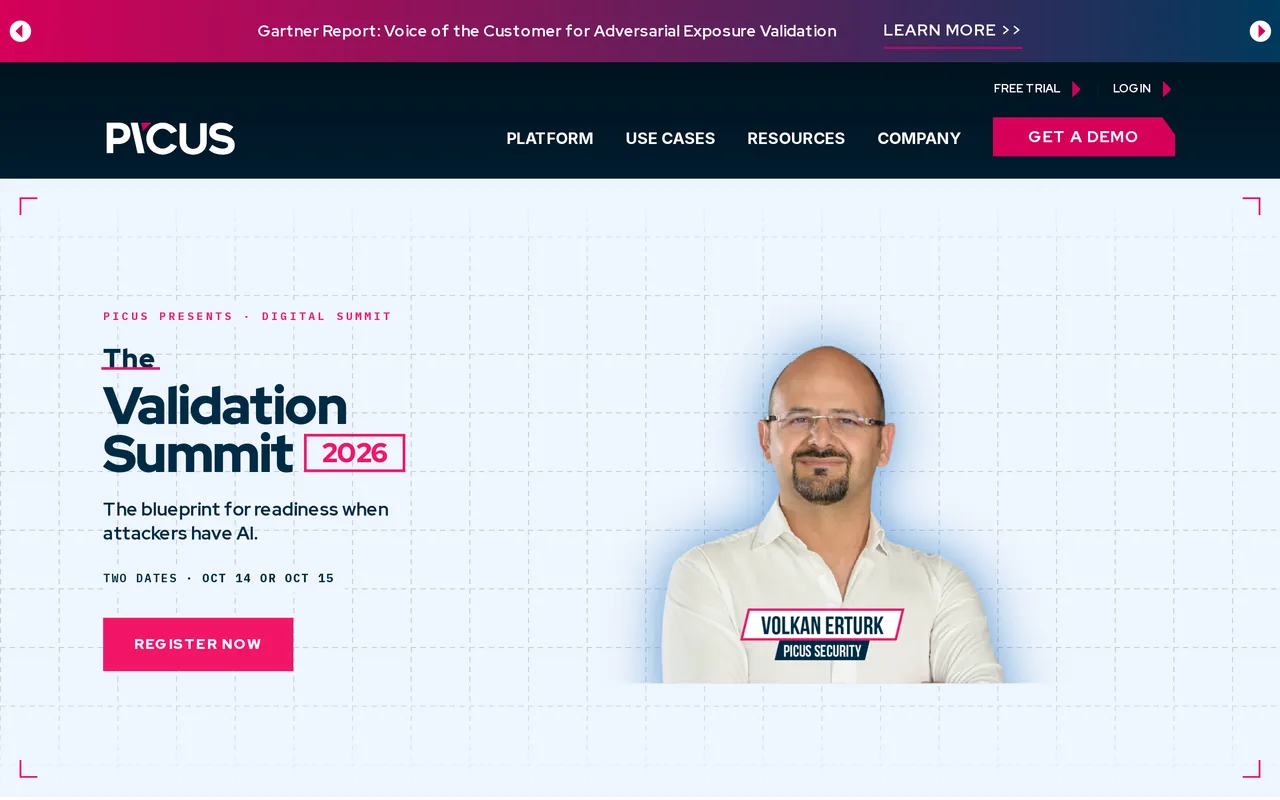
There is a third family in this guide worth naming, because buyers confuse it with the first two constantly. Adversarial exposure validation— the Gartner category that absorbed breach and attack simulation in March 2026 — answers a different question. It does not ask “can someone break in”; it asks “do the controls we already bought actually stop the attacks we care about”. Picus, Cymulate, SafeBreach, AttackIQ and XM Cyber live here. They are excellent at that job and will never find an asset you forgot you owned.
Figure 5 — how we got here
Thirteen years from attack simulation to autonomous agents
2013–16
Breach and attack simulation arrives
Picus, SafeBreach, AttackIQ, Cymulate and XM Cyber are founded within three years of each other. The idea: stop guessing whether your controls work, and fire real attack behaviour at them on a schedule.
2015
Automated security validation gets a name
Pentera is founded as Pcysys and starts arguing that a pentest should be a continuous machine process, not an annual consulting engagement. The industry mostly disagrees for the next five years.
2019
Autonomous pentesting becomes a product
Horizon3.ai is founded and ships NodeZero: an agentless attacker you launch inside your own network with no credentials and no script, which chains its way to domain admin unattended.
2023
Consolidation starts
Kaseya acquires Vonahi Security, putting automated network pentesting into tens of thousands of managed service provider stacks and collapsing the price of a small-business pentest.
June 2025
An AI tops a human leaderboard
XBOW becomes the first autonomous system to reach #1 on HackerOne's US leaderboard, filing roughly 1,060 reports in about ninety days. The argument that machines cannot find real bugs ends here.
Aug 2025
The hybrid model formalises
Synack releases Sara, its autonomous red agent, pairing machine breadth with vetted human depth. Terra Security closes a $30M Series A on the same thesis a month later.
Mar 2026
Gartner collapses the categories
The Market Guide for Adversarial Exposure Validation folds breach and attack simulation and automated penetration testing into one market. Gartner projects 40% of organisations will run formal exposure validation by 2027.
Jul 2026
The incumbents answer
Invicti launches Agentic Pentest, bolting autonomous reasoning onto proof-based DAST. NetSPI expands its continuous platform to pair AI testing with expert validation. The scanners are now agents too.
Aug 2026
Capital floods in
Horizon3.ai raises $250M at a valuation north of $2B — roughly triple its mark fourteen months earlier. BreachLock ships Breach360, trained on 40,000-plus real engagements.
Sep–Oct 2026
The market consolidates and the agents go mainstream
NetSPI and Synack agree to merge under KKR into an 800-person, $200M-plus offensive security business. Hadrian raises $40M. The question stops being whether to automate and becomes how much judgement you are willing to delegate.
The category did not appear in 2025. It took a decade of breach and attack simulation, five years of automated validation, and one credible public benchmark before the market agreed that a machine could run a pentest. The last eighteen months are where the money and the consolidation arrived.
How these thirty were scored
Every platform was evaluated against the same ten criteria on a 1–10 scale, and the published order is simply those scores run through a weighted average. The weights are the defaults in the ranking tool below. That means two things worth stating plainly: the article order and the tool can never disagree, and you can reproduce — or overturn — my ranking in about fifteen seconds.
Criterion
Default weight
What it measures
Autonomy depth
1.50
How much of the attack the engine decides for itself. Does it scope, pivot and improvise past a failed step — or replay a sequence an engineer wrote in advance?
Exploit proof quality
1.50
What a finding arrives with. Extracted data, a replayable request and a screenshot — or a status code, a version banner and a CVE number?
Attack depth in scope
1.30
How far it actually gets inside the ground it claims. A specialist that reaches the database beats a generalist that reaches the login page.
Continuous cadence
1.10
Can it run daily, or on every deploy, without a new statement of work — and does it re-test a fix automatically once you ship it?
Coverage breadth
0.90
How many of the four surfaces it covers: external web and API, internal network and Active Directory, cloud and identity, and security control validation.
Workflow & integrations
0.80
API, CI/CD gates, Jira and ServiceNow, SIEM export, role-based access — how completely it disappears into the process you already run.
Price accessibility
0.80
Entry cost and transparency. A 10 means published, self-serve pricing a small team can buy today without a discovery call.
Human validation
0.70
Access to real operators who triage, confirm and extend what the machine produced, rather than a confidence score you have to trust.
Track record & scale
0.80
Years in market, size of deployed base, reference customers you can call, and the financial stability to still be here in three years.
Compliance reporting
0.70
Attestation letters and evidence an auditor accepts for SOC 2, PCI DSS, ISO 27001, DORA or FedRAMP without a rewrite.
Autonomy and exploit proof carry the most weight because they are what distinguishes this category from vulnerability scanning. Coverage breadth is deliberately weighted below attack depth: a specialist that reaches your database beats a generalist that reaches your login page.
Scoring drew on vendor documentation and pricing pages, publicly reported funding and ownership, Gartner’s 2026 Adversarial Exposure Validation market guide, public benchmark results where they exist, customer reviews, and hands-on familiarity with a number of these products. Homepage screenshots were captured programmatically on 6 October 2026 — one vendor, AttackIQ, blocks automated capture, which is noted in its entry. Self-descriptions are quoted verbatim from vendor sites on the same date so you can see how each company positions itself in its own words rather than mine.
What is deliberately not in the ranking
Analyst placement, logo count, G2 badges and marketing spend are excluded. So is any score for “AI” as a property — every vendor here claims it, so it discriminates nothing. What is measured instead is the observable consequence: how far the engine gets on its own, and what a finding arrives with when it does.
Interactive ranking tool
Rank all 30 platforms by what you are buying
The published order is the Balanced preset. Move a slider and the table below re-sorts live. Nothing is hidden — this is the same arithmetic that produced our ranking, run against your priorities instead of ours.
The published order. Autonomy and proof lead; everything else supports.
Autonomy versus coverage breadth: where the 30 platforms actually sit
Hover or tap a bubble to see what that platform is known for.
Horizontal axis: how much of the attack the engine decides for itself. Vertical axis: how many of the four surfaces (external web and API, internal network and Active Directory, cloud and identity, security control validation) it covers. Bubble size reflects track record and deployed scale. Hover or tap any bubble for the detail. The top-right quadrant is the one everybody is racing toward and almost nobody occupies yet.
The top 30 automated and autonomous pentest platforms
Ranked by the balanced weighting above. Each entry carries the same structure: what it is best at, the company facts, a verdict, the vendor’s own words, strengths, what to watch for, and the single thing that makes it worth a conversation.
AI-native autonomousBest for: Autonomous internal network pentesting at enterprise scale
Headquarters
San Francisco, California, USA
Founded
2019
Ownership & funding
$428.5M total; $250M Series E at $2B+ valuation (Aug 2026)
Entry price
Quote only; buyer data puts the median contract near $18.6k/yr, large estates near $60k
NodeZero is the platform most people actually mean when they say autonomous pentest. You launch a container inside the network, give it no credentials, and it behaves like an operator on day one of an internal engagement: enumerate, harvest, crack, relay, pivot, escalate, and keep going until it owns a domain admin or runs out of paths. The output is not a vulnerability list — it is an attack path with the credential it used and the data it reached at the end.
The $250M Series E in August 2026 at a valuation north of $2B, on top of a Series D a little over a year earlier at $650M, tells you where the money in this category believes the centre of gravity sits. More than 6,500 organisations run it, which also means the engine has been hardened against the thing that kills autonomous tooling in production: unsafe actions. Horizon3 is unusually disciplined about running real exploits without breaking the host.
The gap is on the application side. NodeZero is phenomenal against Active Directory, credential reuse and flat networks, and merely competent against a modern single-page app with a GraphQL backend behind an auth wall. If your risk lives in a B2B SaaS product rather than in a corporate domain, pair it with something web-native rather than expecting it to cover both.
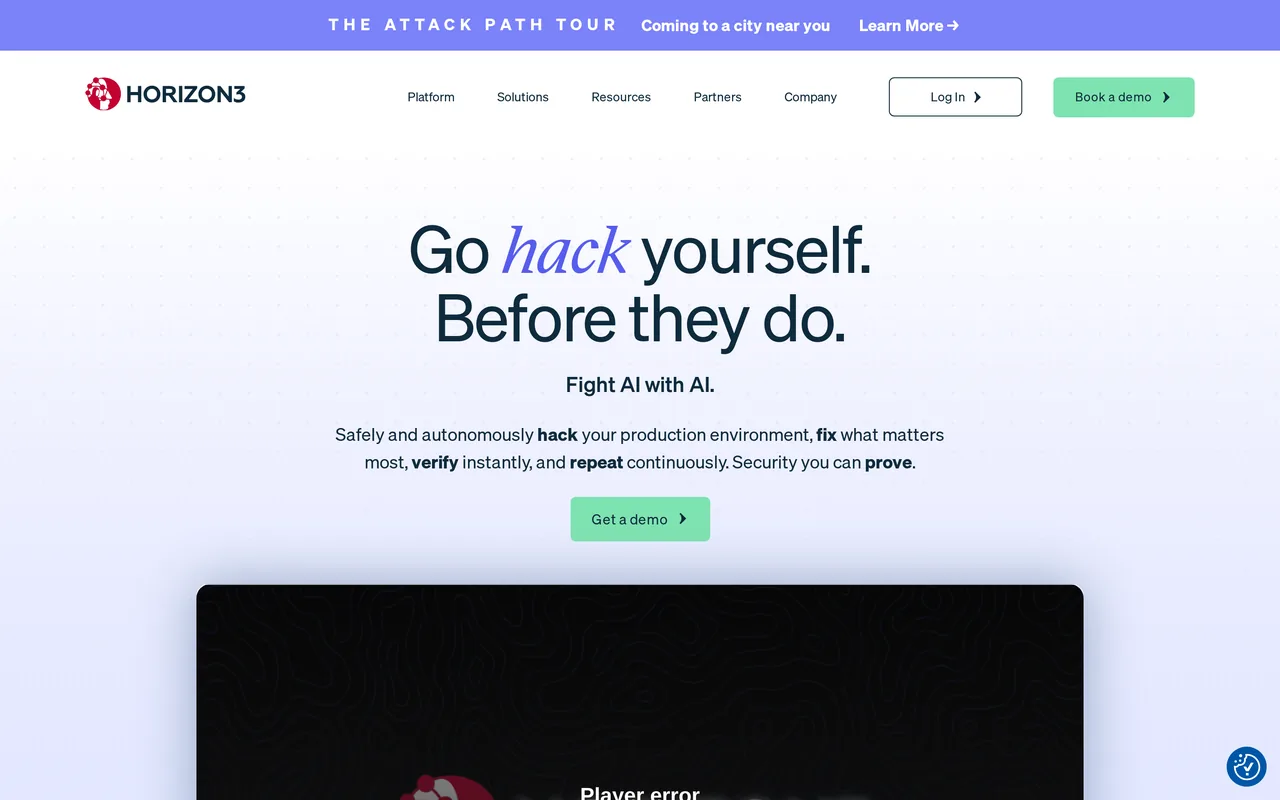
"Horizon3 uses real-world attacks to safely show what attackers can actually do in your environment—so you can fix and prove what matters." — horizon3.ai, October 2026
Strengths
Genuinely unattended internal network attack chaining — no scripts to maintain, no scenario library to curate
Proof of impact is concrete: the credential, the host, the data, the exact path taken
Re-run the identical attack after remediation in one click to prove the fix held
Watch out for
Web application and API testing is the shallow end of the platform relative to its network work
Per-asset pricing scales fast across large or ephemeral estates — model your real asset count before signing
No published price list; expect a procurement cycle rather than a credit card
Standout: Domain compromise proven end-to-end, unattended, repeatable on demand.
Hybrid PTaaSBest for: AI-led testing with vetted human researchers proving what matters
Headquarters
Redwood City, California, USA
Founded
2013
Ownership & funding
$112.3M raised; merger with NetSPI announced September 2026
Entry price
From $4,181 for a Sara AI-led pentest; $10,283 SynackST; $27,120 Synack14
Synack is the clearest example of the hybrid thesis executed well. Sara, the Synack Autonomous Red Agent released in August 2025, runs the breadth — reconnaissance, enumeration, the long tail of testing that humans find tedious — and the vetted Synack Red Team takes the depth, confirming exploitability and chasing the business-logic flaws machines still miss.
What makes it unusually buyable is published pricing in a category that hides it. A Sara-led pentest against one low-complexity web application or 100 hosts starts at $4,181 in a four-to-five day window. That is a number you can put in a budget request without a discovery call, and it is roughly an order of magnitude below a traditional consultancy engagement of similar scope.
The live question is the NetSPI merger announced on 2 September 2026, expected to close in October 2026, creating an 800-person, $200M-plus business backed by KKR. Both companies say cadence, scope and contacts are unchanged through the pre-close period. Buyers signing multi-year deals right now should still get roadmap commitments in writing.
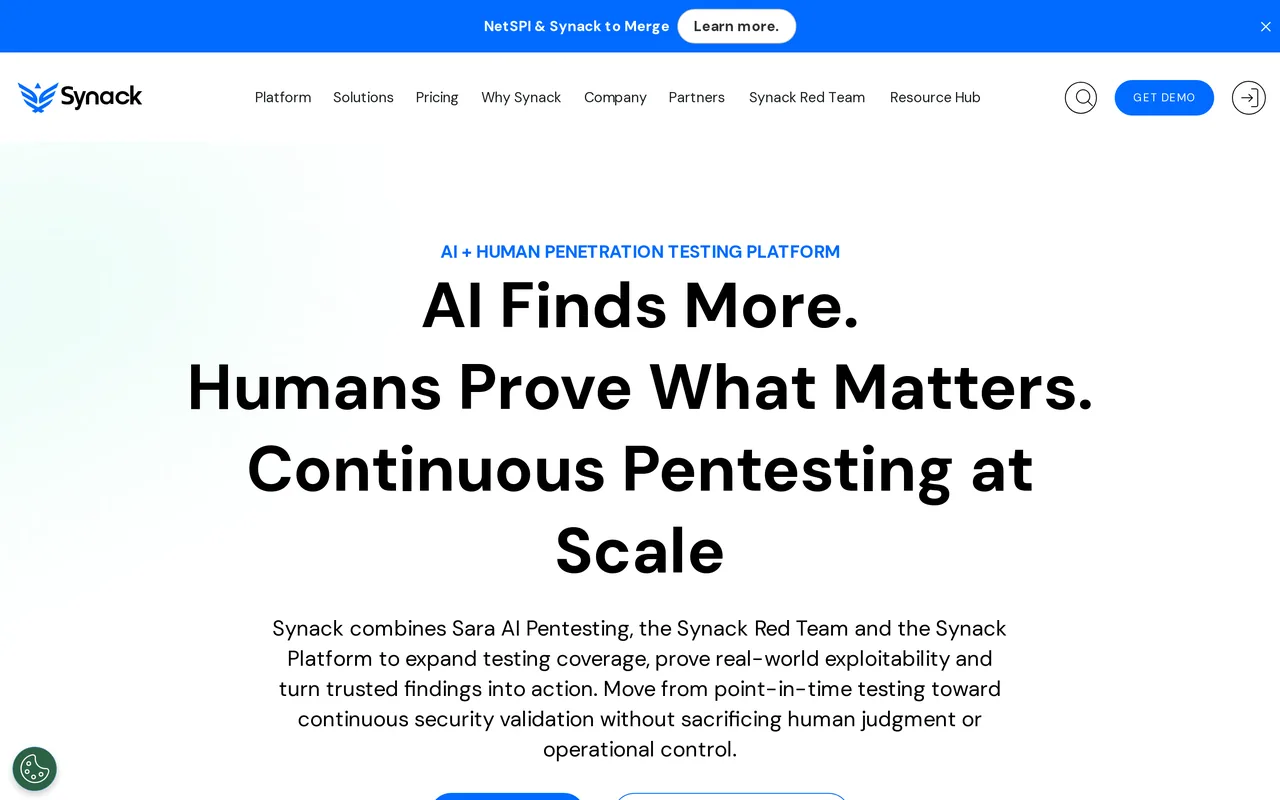
"Synack combines AI-powered penetration testing with elite human researchers to deliver continuous pentesting at scale on a modern PTaaS platform." — synack.com, October 2026
Strengths
Published, specific pricing in a category that almost universally refuses to publish any
Sara handles breadth while vetted researchers handle depth — the division of labour is honest
Government and defence pedigree; FedRAMP-relevant experience the AI-native startups lack
Watch out for
Merger integration risk through the close in October 2026 and the year that follows
Researcher-network scheduling can stretch timelines at quarter end
Two overlapping product families post-merger — insist on roadmap clarity before a multi-year term
Standout: An autonomous agent and a vetted human bench, with the price actually on the website.
Automated exposure validationBest for: Enterprise-wide automated security validation across network, cloud and credentials
Headquarters
Boston, Massachusetts, USA & Petah Tikva, Israel
Founded
2015
Ownership & funding
$249.5M total; $60M Series D (March 2025) at a $1B valuation
Entry price
Typically ~$35k/yr entry, commonly $50k–$120k/yr by asset count and module
Pentera invented the market language everyone else now borrows. "Automated security validation" was their phrase before Gartner folded breach-and-attack simulation and automated pentesting into the Adversarial Exposure Validation category in March 2026, and the product has the maturity that a decade of iteration buys: Core for internal networks, Surface for the external perimeter, Cloud for AWS and Azure attack paths, and credential exposure testing that checks your leaked passwords against your own live directory.
What distinguishes it from the AI-native cohort is temperament. Pentera is engineered to be run continuously in production by a risk-averse enterprise, which means the attack library is curated, the blast radius is bounded, and the compliance reporting is good enough that auditors stop arguing. With roughly $117M in reported ARR and a $1B valuation, it is also the safest procurement decision in this list after the public companies.
The flip side of that curation is the ceiling. Pentera is a superb rules-and-techniques engine with AI layered on top; it is not an agent that will improvise its way past an unusual application behaviour the way XBOW or NodeZero will. For most enterprises that tradeoff is correct. For anyone buying specifically to find the weird thing nobody scripted, it is a real limitation.
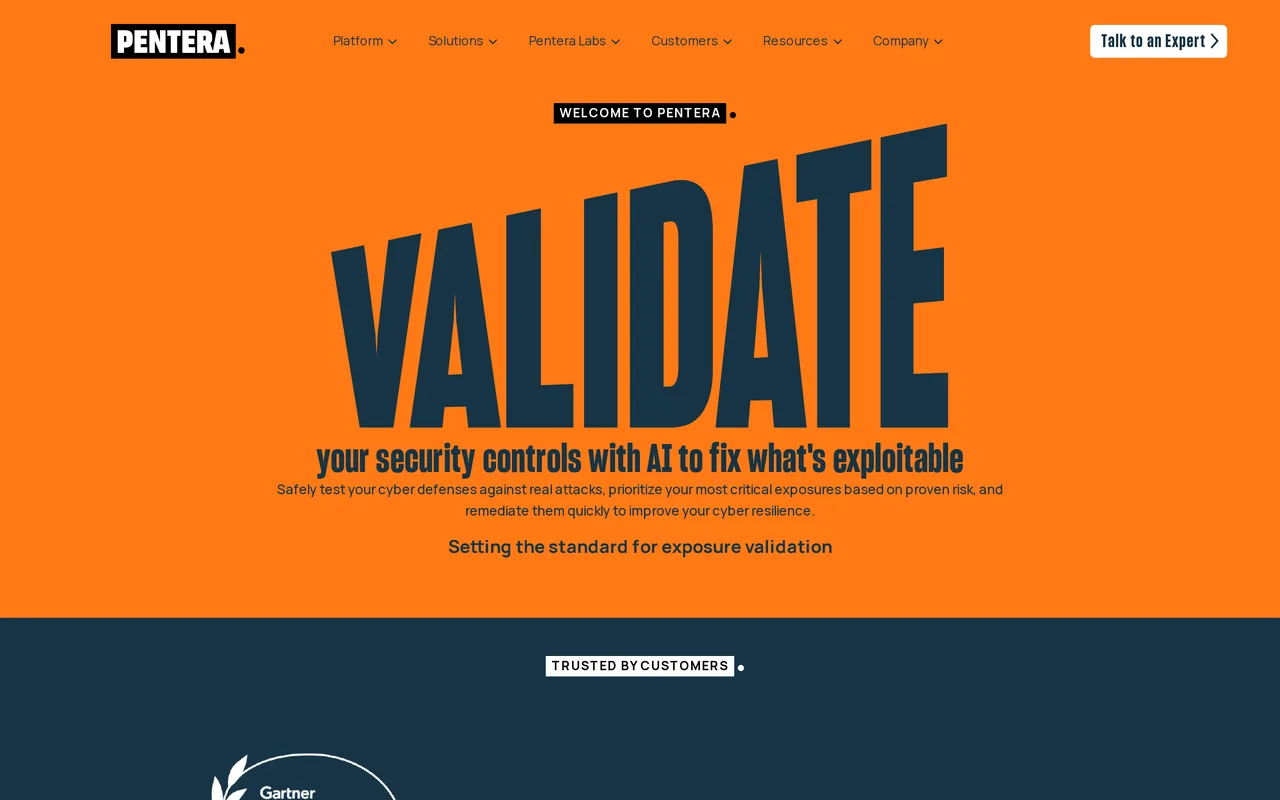
"The Pentera Platform executes AI-driven adversarial testing in production to validate exploitability, prioritize remediation, and reduce exposure." — pentera.io, October 2026
Strengths
Broadest single-vendor coverage here: internal, external, cloud and credential exposure in one platform
Built for continuous production use with a bounded blast radius — the safety engineering is excellent
Reporting that survives contact with auditors and boards without rewriting
Watch out for
Technique-library driven rather than genuinely improvisational — it stops at the edge of what was encoded
One of the most expensive entries in the guide, with modules priced separately
Application-layer business logic is not its strong suit
Standout: The category's most complete enterprise validation platform, and the one auditors already recognise.
Hybrid PTaaSBest for: Agentic pentesting backed by a very large corpus of real engagements
Headquarters
New York, USA & Amsterdam, Netherlands
Founded
2018
Ownership & funding
Modest disclosed venture funding; grown largely on services revenue
Entry price
From roughly $4k per application pentest; platform subscriptions for continuous programmes
BreachLock spent years as a high-volume human pentest shop with a decent portal, and then did the thing that turns out to matter most in this category: it used that history as training data. Breach360, launched in August 2026, is an agentic autonomous pentest product whose claim to accuracy rests on 40,000-plus real engagements rather than on a model vendor's benchmark.
That corpus is a genuine moat. The difference between an agent that knows which of fifty plausible payloads actually worked against a real customer stack and one that reasons from first principles every time is measured in false positives. BreachLock also kept human approval gates for production-affecting actions and optional reviewer sign-off, which is how you sell autonomy to a regulated buyer.
Being named a Representative Vendor in the 2026 Gartner Market Guide for Adversarial Exposure Validation put it in front of enterprise procurement. The watch-out is positioning: BreachLock sells attack surface discovery, automated pentesting, agentic pentesting and human-led testing from one brand, and buyers routinely end up in the wrong tier. Pin down exactly which engine is testing you.
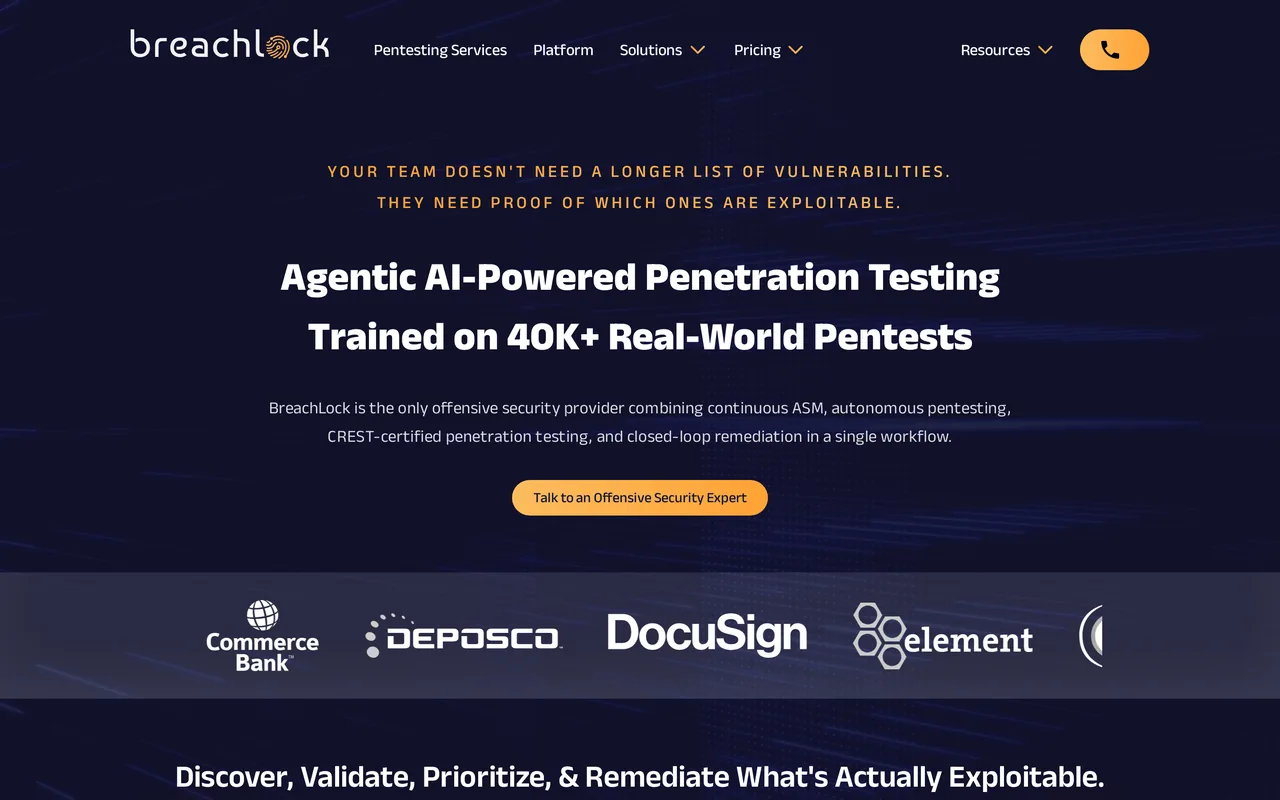
"Agentic AI-Powered Penetration Testing — Trained on 40K+ Real-World Pentests." — breachlock.com, October 2026
Strengths
A 40,000-engagement corpus feeding the agent — the largest validated training signal in the category
Human approval gates and optional reviewer sign-off make it defensible in regulated production
Accessible entry price for a platform with this much enterprise credibility
Watch out for
Four overlapping product tiers — buyers frequently sign the wrong one
Small disclosed funding relative to the venture-backed cohort it now competes against
Agentic product is new (August 2026); the long-run accuracy record is still being written
Standout: Forty thousand real pentests turned into training data for the agent.
Hybrid PTaaSBest for: Enterprise PTaaS where human depth is non-negotiable
Headquarters
Minneapolis, Minnesota, USA
Founded
2001
Ownership & funding
KKR growth investment; merger creates a $200M+ revenue, ~800-person business
Entry price
Enterprise engagements, typically $30k–$150k+ per programme
NetSPI is the counterweight in this guide. Twenty-five years old, KKR-backed, with one of the largest in-house offensive benches in the industry, it represents the position that context, business logic and attacker judgement do not automate — and it has the regulated-industry client list to argue the point.
That position has been softening in the right direction. In July 2026 NetSPI expanded its continuous pentesting platform to pair AI-driven testing with expert-validated findings, which is the same hybrid architecture Synack, Terra and BreachLock arrived at from different directions. The merger with Synack, announced on 2 September 2026 and expected to close in October 2026, formalises it: elite human talent on one side, agentic AI continuous testing on the other, nearly forty years of combined operating history and more than 13 million hours of offensive testing between them.
Buy NetSPI when the deliverable has to withstand a regulator, a board or a customer security questionnaire from a Fortune 100 account. Do not buy it expecting autonomous-platform economics — this is consulting-grade pricing with a very good platform attached.
"NetSPI is the proactive security solution used to discover, prioritize, and remediate security vulnerabilities of the highest importance." — netspi.com, October 2026
Strengths
Deepest human bench in this guide, with 13 million-plus hours of offensive testing behind it
Reports and attestations that satisfy the most demanding regulated buyers
July 2026 platform expansion pairs AI testing with expert validation on every finding
Watch out for
Consulting-grade pricing — the most expensive way to reach a given level of coverage
Merger integration with Synack runs through late 2026 and beyond
Human scheduling means cadence is measured in weeks, not hours
Standout: The human bench everyone else benchmarks their AI against.
AI-native autonomousBest for: Continuous AI pentesting for SaaS, APIs and cloud with published pricing
Headquarters
Europe, with distributed delivery
Founded
2024
Ownership & funding
Bootstrapped
Entry price
$79/mo (annual) Starter, $249/mo Professional, $499/mo Business, enterprise from $15k
Disclosure first: Pentestas publishes this guide. Treat the placement as our own argument rather than as a neutral verdict, and weight the criteria yourself with the tool above — it will happily rank us lower if your priorities differ from the defaults.
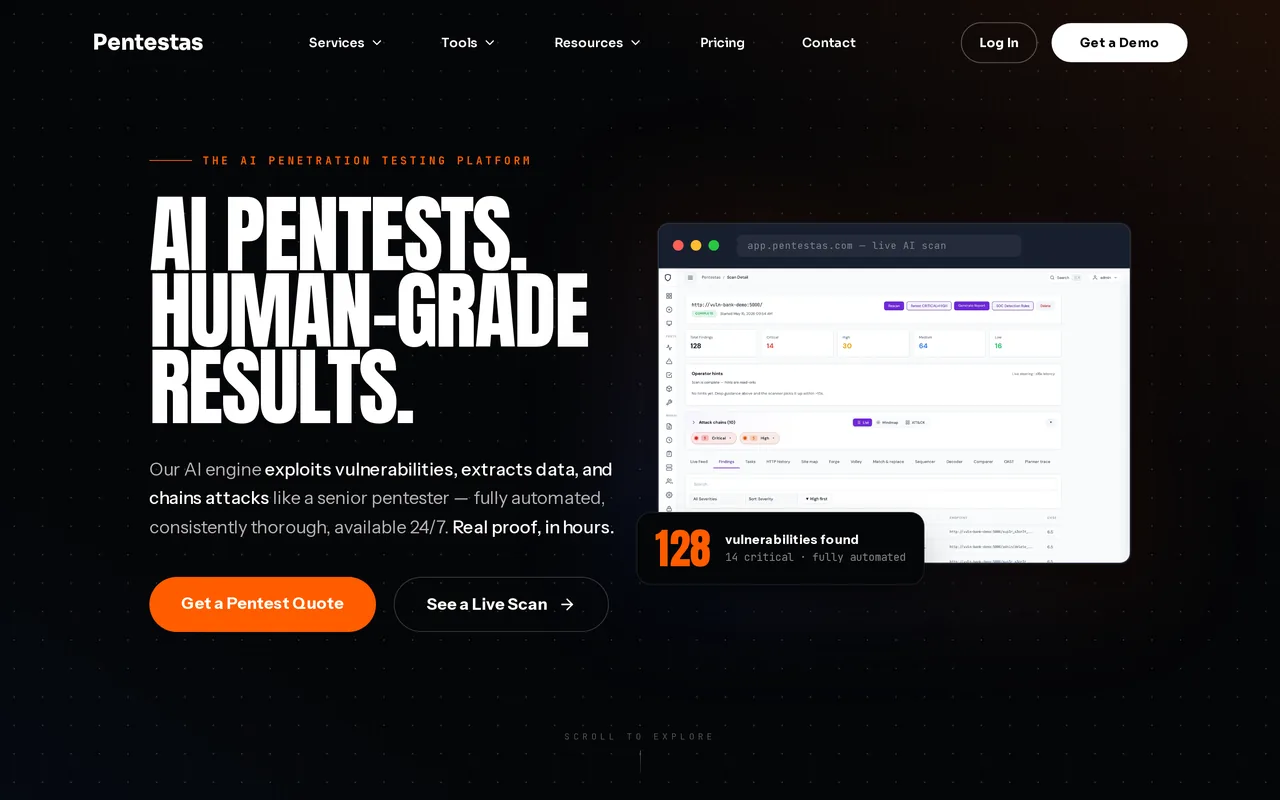
The engineering position is specific. The exploitation engine runs multiple frontier models rather than one, because the models fail differently: a chain that one refuses or fumbles, another completes. Every discovery passes through a central response-authenticity oracle before it is allowed to become a finding, which exists because the fastest way to destroy trust in an AI penetration testing system is to report a 200 OK as a breach. Findings ship with the replayable request, the extracted evidence and the proof — not a severity badge over a status code.
Coverage is deliberately shaped around modern product companies: authenticated single-page app crawling with JS-bundle endpoint mining, REST and GraphQL abuse, mobile backends behind APK and IPA analysis, Azure and Entra ID inspectors, and MCP server scanning for teams shipping AI agents. Pricing is published from $79/month. The honest limitation is scale of deployed base — we do not have Pentera's decade or Horizon3's 6,500 logos, and a buyer who needs that kind of reference depth should weigh it accordingly.
"AI pentests. Human-grade results." — pentestas.com, October 2026
Strengths
Multi-model exploitation engine — a chain one model fails, another completes
Central authenticity oracle gates every finding, so status-code-only reports never ship
Published self-serve pricing from $79/month with no discovery call required
Watch out for
We publish this ranking — read our placement with that in mind
Smaller deployed base than the decade-old incumbents in this guide
Internal Active Directory testing is lighter than NodeZero or Pentera
Standout: Every finding carries a replayable request and extracted evidence, or it does not ship.
Hybrid PTaaSBest for: On-demand pentests with a credit model and a new autonomous tier
Headquarters
San Francisco, California, USA
Founded
2013
Ownership & funding
~$79M total venture funding
Entry price
$3,500 per Autonomous Pentest (promotional, through 31 Dec 2026); credits ~$1,800 each; typical annual spend $15k–$40k
Cobalt effectively created pentest-as-a-service as a product category: buy credits, schedule a test, get a vetted researcher from the Cobalt Core, receive a report your auditor accepts. A decade later the model still works, and roughly 500 vetted freelance testers give it scheduling flexibility the boutique shops cannot match.
The 2026 development that puts it in this guide is the Autonomous Pentest tier, offered at a published $3,500 promotional price through 31 December 2026. That is Cobalt acknowledging what the AI-native entrants proved: there is a layer of testing that no longer justifies a human hourly rate. Buyers get a genuinely useful ladder — autonomous for continuous coverage, credits for human depth when it matters.
The friction is the credit model itself. One credit is eight hours of testing, blended around $1,800, and estimating credits for an unfamiliar scope is where most buyers overspend. Get the scoping call right or you will buy a quarter of coverage you never consume.
"Offensive security services from human-led to autonomous pentesting. Identify exposures, get ahead of threats, and maintain compliance—fast and precise." — cobalt.io, October 2026
Strengths
Mature, proven PTaaS workflow that auditors and procurement already understand
Published $3,500 autonomous tier gives a real entry point below human engagement pricing
Large vetted researcher pool means short lead times even at quarter end
Watch out for
Credit estimation is the main source of overspend — scope carefully before committing
Autonomous tier is newer and shallower than the AI-native specialists
Researcher quality varies more across a marketplace than with a fixed in-house bench
Standout: A published autonomous price in a market that still hides its rate card.
Hybrid PTaaSBest for: Continuous pentesting with unlimited retests and named human testers
Headquarters
Madison, Wisconsin, USA
Founded
2017
Ownership & funding
$8M Series A led by Blueprint Equity
Entry price
Custom; mid-market programmes commonly land in the $20k–$60k/yr range
Sprocket's homepage headline is the most honest sentence on any website in this guide, and it maps exactly to how the product works. Automation runs the continuous monitoring layer — new asset appears, attack surface changes, a technique lands in the wild — and a named human testing team you can actually email handles the exploitation and the judgement calls.
The commercial innovation is unlimited retests at no additional cost. Every other model in this category penalises you for fixing things: you patch, you want confirmation, you buy another engagement. Sprocket re-tests whenever a finding is remediated, infrastructure changes, or a new technique emerges, for the same fee. For a mid-market team under compliance pressure, that single term changes the economics more than any feature comparison.
The ceiling is scale. This is a focused company with a Series A, not a platform that will absorb a 50,000-asset enterprise estate. Within the mid-market it is one of the best-value entries here.
"Yes, we have AI. We also have kickass humans." — sprocketsecurity.com, October 2026
Strengths
Unlimited retests included — remediation verification stops being a line item
A named human team rather than an anonymous queue, which matters at 4pm on a Friday
Continuous monitoring catches attack surface changes between scheduled tests
Watch out for
Smaller company; enterprise-scale estates will outgrow it
No published pricing
Automation layer is monitoring and triage, not autonomous exploitation
Standout: Unlimited retests — you are never charged for proving you fixed it.
Amsterdam, Netherlands & London, UK & New York, USA
Founded
2021
Ownership & funding
~$65M total; $40M (€35.68M) round announced October 2026
Entry price
Quote; scoped by attack surface size
Hadrian solves the problem that quietly undermines every other entry in this guide: you cannot pentest what nobody told you about. Its agents start from the outside with no asset inventory, discover what you actually expose — forgotten subdomains, staging environments, third-party SaaS tenants, shadow IT — and then attack what they find, continuously.
The design detail worth noting is that Hadrian puts a second AI in the validation path, reviewing the first one's conclusions before they reach a customer. That is a structurally different answer to the hallucination problem than "a human checks it", and it scales differently. Being named a Representative Vendor in Gartner's 2026 AEV market guide, alongside a $40M round in October 2026 that brings the total to roughly $65M, suggests the approach is landing.
Hadrian is an external-perspective product by conviction. There is no internal network module and there will not be one soon. If your crown jewels sit behind a VPN, this is a complement to something else rather than a replacement for it.
"Hadrian's AI agents map everything you expose, attack it like real adversaries and pentest it continuously. Proof, not noise." — hadrian.io, October 2026
Strengths
Discovery-first: finds the assets your inventory missed, then attacks them without being asked
A second AI validates the first one's findings — a scalable answer to false positives
Named a Representative Vendor in Gartner's 2026 Adversarial Exposure Validation market guide
Watch out for
External perspective only — nothing inside the perimeter
Continuous discovery against a sprawling estate can surface more than a small team can action
European-headquartered support footprint may not suit US-only buyers wanting local hours
Standout: Finds the asset you forgot you owned, then proves it is exploitable.
Crowdsourced platformBest for: Crowdsourced depth plus AI triage and AI red teaming
Headquarters
San Francisco, California, USA
Founded
2012
Ownership & funding
~$160M total
Entry price
Pentest assessments from roughly $15,000; bounty costs variable on top
HackerOne is in this guide for context as much as for capability. It is the largest researcher community in the world, it runs the leaderboard XBOW topped in 2025, and it has layered AI into triage — the Hai assistant — and into AI red teaming for organisations shipping LLM features.
As a buying decision it is a different instrument from the rest of the list. Bug bounty economics are variable and outcome-linked: you pay for what is found, which can be excellent value or an unbudgeted surprise. Its PTaaS tier, from roughly $15,000, is conventional and competent.
What it is not is an autonomous platform you point at an estate on a schedule. It is a market for human attention with AI assistance around the edges. Run it alongside an autonomous engine: the machine covers the continuous, repeatable breadth, the crowd finds the creative outlier. Its position here is set almost entirely by the autonomy criterion — move that slider down in the ranking tool and HackerOne climbs several places immediately, which is exactly the point.
"HackerOne combines AI with the ingenuity of the largest community of security researchers to find and fix security, privacy, and AI vulnerabilities across the SDLC." — hackerone.com, October 2026
Strengths
The largest security researcher community in the world, with genuine creative reach
AI triage meaningfully reduces the operational burden of running a bounty programme
AI red teaming for organisations shipping LLM-powered features
Watch out for
Not an autonomous platform — this is a marketplace for human attention
Bounty costs are variable and hard to budget precisely
Programme management overhead is real and routinely underestimated
Standout: The largest researcher crowd on earth, with AI doing the triage.
AI-native autonomousBest for: Autonomous web and API exploitation with reproducible proof
Headquarters
San Francisco, California, USA
Founded
2024
Ownership & funding
Reported ~$237M total; $120M round announced March 2026, plus a $35M strategic extension
Entry price
Enterprise quote only
XBOW earned its position with the single most legible proof point anyone in this category has produced: in June 2025 it became the first autonomous system to reach #1 on HackerOne's US leaderboard, filing roughly 1,060 reports across live bug bounty programmes in about ninety days against thousands of human researchers. Whatever you think of leaderboard reputation as a metric, that is a public, adversarial, independently refereed benchmark — which is more than almost any vendor in this guide can point to.
Architecturally it is the opposite bet to Horizon3. XBOW reasons about web applications and APIs the way a strong manual tester does: read the app, form a hypothesis, build a payload, observe, revise. When it reports, it reports with a reproducible proof-of-concept, which is the only currency that matters to a developer being asked to stop shipping features and fix something.
Two caveats explain why it does not top the balanced ranking. It is priced for companies with a real application security budget, not for a mid-market IT team, and it is deliberately narrow — an application and API attacker, not a network or identity one. Switch the ranking tool to the Pure autonomy preset, where breadth and price carry almost no weight, and XBOW jumps to second. On raw autonomy, proof and depth it is tied with the leader. Buy it for the product you sell, not for the domain you run.
"XBOW is an autonomous offensive security platform that simulates real attacks to find and validate vulnerabilities in your applications." — xbow.com, October 2026
Strengths
The strongest public, adversarial benchmark in the category — a top-ranked HackerOne result against human researchers
Findings arrive as reproducible proof-of-concept exploits, not inferred risk
Strategic backing from Accenture, NVIDIA and Samsung points to long-term staying power
Watch out for
Application and API scope only — no internal network, Active Directory or identity attack paths
Enterprise pricing with no published entry point; not a mid-market purchase
Young company relative to the estate sizes it now sells into
Standout: The first autonomous system to out-rank every human on a national bug-bounty leaderboard.
AI-native autonomousBest for: Agentic web app pentesting with a human reviewer on every finding
Headquarters
Tel Aviv, Israel & New York, USA
Founded
2024
Ownership & funding
$38M total; $30M Series A led by Felicis (September 2025)
Entry price
Quote; mid five figures annually for a continuous multi-app programme
Terra built the architecture most of this category is converging on: agents that reason per-target and build a persistent model of each application, with a human operator who reviews before anything reaches the customer. The agents do not start from a generic checklist — they learn the application's own logic, which is exactly where automated scanners historically fall over.
That human-in-the-loop design is the commercial point. The hardest objection to autonomous pentesting is not "can it find things" but "how much of my week will I spend disproving what it found". Terra answers that structurally rather than with a confidence score, and the Fortune 500 logos it has accumulated since the 2024 founding suggest the answer holds up.
It is young, application-scoped and priced as a programme rather than as a tool. If you want continuous coverage of a portfolio of web products and you have been burned by scanner noise, this is the shortlist entry that most directly addresses that scar.
"Terra is the Agentic Offensive Security company. Delivering Agentic AI + Human-in-the-Loop continuous pentesting at scale." — terra.security, October 2026
Strengths
Per-application context model rather than a generic payload library — it learns your app's logic
Human review on findings before delivery, which collapses triage overhead
Continuous by design, so coverage tracks releases instead of lagging a quarter behind
Watch out for
Web and API scope — no internal network or Active Directory testing
Founded in 2024; smaller support organisation than the incumbents it competes with
Human-in-the-loop adds latency compared with fully unattended engines
Standout: Agentic depth with a human signature on every finding that leaves the building.
Hybrid PTaaSBest for: Transparent, published pricing for continuous pentesting at SMB scale
Headquarters
Claymont, Delaware, USA & Bengaluru, India
Founded
2018
Ownership & funding
$2.7M growth round; lean, revenue-led growth
Entry price
$1,999/yr Pentest Basic, $5,999/yr Pentest Plus — per target, published
Astra does something almost nobody at this capability level does: it puts the price on the website. $1,999 a year for Pentest Basic, $5,999 for Pentest Plus, per target. For a startup that needs a SOC 2 attestation and a credible continuous testing story without a procurement cycle, that transparency is worth more than a feature it will never use.
The product pairs an AI engine that exploits web, API and cloud flaws with human researcher validation, plus developer-facing integrations — CI/CD gates, Jira, Slack — that reflect its SMB and mid-market customer base. The compliance reporting is deliberately mapped to SOC 2, ISO 27001, GDPR and PCI DSS, which is what most of its buyers are actually trying to survive.
It will not satisfy an enterprise with a complex internal estate, and the autonomy is real but shallower than the frontier-model entrants. As the entry point into credible automated pentesting, it remains one of the best-value options in the guide.
"Astra Security is a one of a kind AI powered automated Pentest Platform that makes chaotic pentests a breeze & continuous with its hacker-style vulnerability scanner." — getastra.com, October 2026
Strengths
Published per-target pricing from $1,999/yr — no discovery call required
Compliance reporting mapped to the frameworks SMB buyers actually face
Human verification included rather than sold as an upgrade
Watch out for
Per-target pricing becomes uneconomic across a large portfolio
Lighter autonomy than the frontier-model entrants
No internal network or Active Directory testing
Standout: Credible continuous pentesting with the price printed on the page.
Automated scanning & ASMBest for: Continuous red teaming bundled into an existing vulnerability management estate
Headquarters
Boston, Massachusetts, USA
Founded
2000
Ownership & funding
Publicly traded
Entry price
Quote; typically bundled into a Command Platform agreement
Rapid7 is the pragmatic choice for organisations already standardised on InsightVM and the Command Platform. Vector Command, launched in 2024 and extended with Vector Command Advanced in 2025, adds continuous red teaming and exposure validation on top of attack surface management — external assets discovered, exposures enumerated and validated, with elite red teamers in the loop, and internal network and segmentation testing in the advanced tier for PCI, ISO 27001 and NIST obligations.
The advantage is consolidation. Findings land in the same console, the same ticketing integration and the same reporting your team already uses, which eliminates the integration tax that kills most point-solution purchases six months in. Metasploit's institutional knowledge sits behind the exploitation work.
The disadvantage is equally clear: this is a managed service bolted onto a platform, not a purpose-built autonomous engine. Specialists will out-test it on depth, speed and price per finding. Buy it because consolidation genuinely saves you more than depth would earn you — not because it is the best attacker in this guide.
"Outpace attackers with the only endpoint to cloud, unified cybersecurity platform." — rapid7.com, October 2026
Strengths
Findings flow into the console, tickets and reporting your team already runs
Managed red team expertise included rather than hired separately
Internal network and segmentation testing in the advanced tier for PCI, ISO 27001 and NIST
Watch out for
Managed service economics, not autonomous platform economics
Specialists beat it on depth and speed per finding
Most valuable only if you are already on the Command Platform
Standout: Continuous red teaming that lands in the console your team already lives in.
Quote; typically $20k–$100k+/yr by site and application count
Invicti's proof-based scanning has been the strongest answer to DAST false positives for years: the scanner does not report a vulnerability unless it has safely exploited it and captured the evidence. Running that across thousands of applications is a scale almost nothing else in this guide attempts.
On 29 July 2026 Invicti launched Agentic Pentest, combining autonomous AI reasoning with that proof-based engine — the agent explores and hypothesises where reasoning helps, while deterministic validation confirms what it finds. For enterprises that need both scale and evidence, that hybrid is a sensible architecture rather than a press release.
The caution is that the agentic layer is three months old at the time of writing and the surrounding platform is a mature DAST product with DAST assumptions. If your application portfolio is enormous and your current problem is scanner noise across thousands of sites, this is a strong fit. If you want a single application attacked with real creativity, the specialists go deeper.
"Accurate and automated application security testing that scales like no other solution. Secure thousands of websites, applications, and APIs with the industry's only DAST-first AppSec platform." — invicti.com, October 2026
Strengths
Proof-based scanning: nothing is reported without captured exploitation evidence
Scales across thousands of applications and APIs with mature CI/CD integration
Agentic Pentest (July 2026) adds autonomous reasoning on top of deterministic validation
Watch out for
Agentic layer is very new; most of the platform is still classic DAST
Enterprise licensing complexity across sites and applications
Depth per application trails the AI-native specialists
Standout: Exploitation evidence attached to every finding, across thousands of applications.
FireCompass combines two things most vendors sell separately: continuous automated red teaming that discovers your external estate the way an attacker would, and agentic AI that then exploits and chains what it finds. The claimed sub-2% false positive rate is an aggressive public number, and the company is unusually willing to be held to it.
The practical strength is attack path chaining across discovered assets. Finding an exposed staging environment is table stakes; demonstrating that the staging credential opens a production API is the finding that actually moves a remediation ticket. FireCompass is built around that second step.
Verify the claims in your own proof of concept rather than from the marketing. Run it against a target where you already know the answer — a recent manual pentest report is ideal — and measure the false positive rate yourself. That advice applies to every vendor here, but it applies hardest to the ones publishing precise accuracy numbers.
"FireCompass is an agentic AI penetration testing platform for web apps and APIs. Discover every asset, prove exploits, and chain attack paths. Under 2% FPR." — firecompass.com, October 2026
Strengths
Discovery and exploitation in one loop — chains attack paths across assets you did not inventory
Published false-positive target, which is rare and testable
Mid-market pricing for capability that usually carries enterprise pricing
Watch out for
Smaller support organisation than the funded leaders
Accuracy claims should be verified against a target where you already know the ground truth
External and application focus; no meaningful internal network coverage
Standout: Discovery and agentic exploitation in a single continuous loop.
Crowdsourced platformBest for: Crowdsourced testing with structured PTaaS and AI-assisted matching
Headquarters
San Francisco, USA & Sydney, Australia
Founded
2012
Ownership & funding
~$236M total
Entry price
PTaaS roughly $15,000–$50,000 per engagement; standard pentest units from $5,000 via AWS Marketplace
Bugcrowd's differentiator is matching. Its platform profiles researcher skills against your specific technology stack and engagement type, so a GraphQL-heavy fintech gets testers who have broken GraphQL-heavy fintechs. That curation is the part of crowdsourced security that most consistently justifies the model.
The PTaaS tier is structured and auditor-ready, and buying standard pentest units from $5,000 through AWS Marketplace is a genuinely useful procurement shortcut for teams whose cloud spend is already committed. Engagements typically run $15,000 to $50,000.
Like HackerOne, it sits mid-table here because it is a fundamentally different instrument — human attention, organised well, with AI assisting the matching and triage rather than doing the attacking. Weight human validation heavily in the ranking tool and it climbs into the top five; weight autonomy heavily and it falls to the bottom. Judge it against other crowdsourced platforms, not against NodeZero.
"Bugcrowd teams with elite security researchers to reduce risk & improve security ROI through our bug bounty, pen testing, & vulnerability disclosure programs." — bugcrowd.com, October 2026
Strengths
Researcher-to-stack matching that genuinely improves relevance of findings
Structured, auditor-ready PTaaS alongside the bounty programme
AWS Marketplace units simplify procurement against committed cloud spend
Watch out for
Human-powered, not autonomous — different economics and different cadence
Bounty budgets are variable and need active management
Overlapping product tiers make it easy to buy the wrong one
Standout: Researchers matched to your exact stack rather than drawn from a general pool.
Automated exposure validationBest for: Continuous automated red teaming across a broad control stack
Headquarters
Tel Aviv, Israel & New York, USA
Founded
2016
Ownership & funding
$141M total; $70M Series D
Entry price
Quote; typically $35k–$90k/yr by module and scale
Cymulate is the broadest of the exposure validation platforms, and breadth is both its pitch and its risk. One subscription covers breach-and-attack simulation, continuous automated red teaming, attack surface management and control optimisation, which means a mid-sized security team can consolidate four line items into one.
The continuous automated red teaming module is the part that overlaps this guide most directly: it chains techniques across an environment rather than firing isolated simulations, which gets closer to an attack path than classic BAS. Customer sentiment is unusually strong — it carried a Gartner Peer Insights Customers' Choice designation in 2026 — and the module structure means you can start narrow and grow.
What it is not is an autonomous attacker. Cymulate executes known adversary behaviour at scale with excellent reporting; it does not reason its way into an unanticipated path. Also budget for the deployment: agents across a real estate take weeks, not an afternoon.
"Agentic cyber defense engineering with continuous exposure validation, automated security testing, threat validation, and security control optimization." — cymulate.com, October 2026
Strengths
Consolidates BAS, continuous red teaming, attack surface management and control optimisation in one platform
Strong customer satisfaction signal — a 2026 Gartner Peer Insights Customers' Choice designation
Modular, so you can buy one capability and expand without replatforming
Watch out for
Simulation-driven rather than improvisational — no reasoning past the encoded technique set
Agent rollout across a large estate is a multi-week project
Breadth can dilute depth; specialists beat it on any single axis
Standout: Four security-validation line items collapsed into one subscription.
Automated exposure validationBest for: Validating that your existing security controls actually stop attacks
Headquarters
San Francisco, California, USA & Ankara, Turkey
Founded
2013
Ownership & funding
~$80M total; $45M Series C (September 2024)
Entry price
Quote; typically $40k–$100k/yr by environment size
Picus answers a different question from the autonomous pentest cohort, and it is a question most organisations cannot answer: do the controls we already paid for actually work? It fires real attack behaviours at your EDR, firewall, email gateway and SIEM, measures what got through, and then hands you the specific detection rule or policy change that closes the gap.
That last part is the differentiator. Breach-and-attack simulation vendors have been showing people red squares for a decade; Picus ships mitigation content — vendor-specific signatures and rules — so the finding has a fix attached. Detection rule validation in particular catches the failure mode nobody budgets for: the SIEM rule that silently stopped firing eight months ago.
It is not a pentest platform and does not pretend to be. Picus will not discover an unknown asset or chain its way to domain admin through a path nobody anticipated. Run it alongside an autonomous pentest engine, not instead of one — the two produce genuinely complementary evidence.
"Picus proves what attackers can exploit and what your defenses stop, turning every exposure into a defensible decision at the speed AI-era threats demand." — picussecurity.com, October 2026
Strengths
Control validation with mitigation content attached — findings arrive with the rule that fixes them
AI-native autonomousBest for: High-signal autonomous testing for engineering-led security teams
Headquarters
San Francisco, California, USA
Founded
2024
Ownership & funding
$40M led by Khosla Ventures (March 2026)
Entry price
Quote; positioned as an annual programme rather than per-test
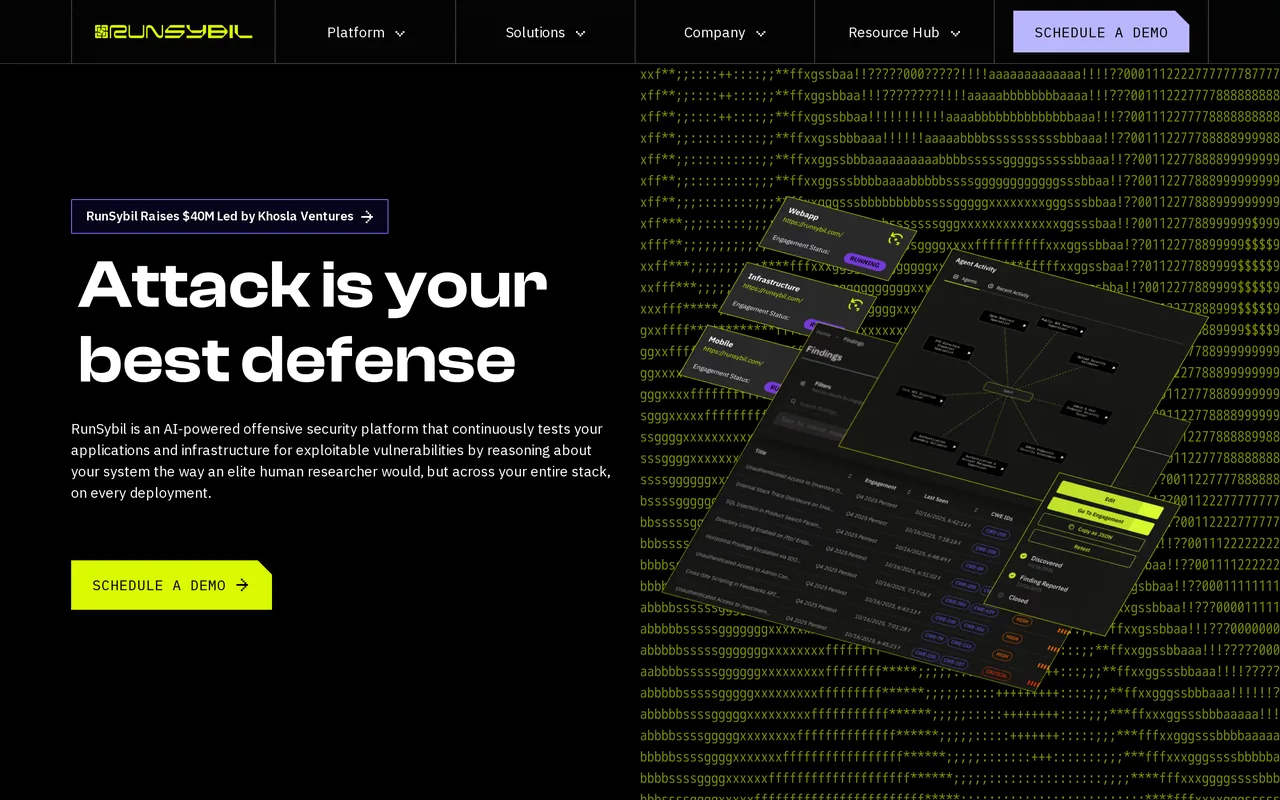
RunSybil has the most interesting founding team in the category: Ari Herbert-Voss was OpenAI's first security research hire, and Vlad Ionescu led Meta's Red Team X. That combination — someone who knows exactly how far a frontier model can be pushed, and someone who has run offensive operations at hyperscaler scale — shows up in the product as an unusual obsession with signal-to-noise.
The customer list is the tell. Cursor, Notion, Baseten and Thinking Machines Lab are companies with strong internal engineering cultures and very low tolerance for security tooling that cries wolf. They do not buy scanners. The $40M from Khosla in March 2026 funded the move from that design-partner cohort into regulated enterprise and financial services.
It is early. There is less compliance scaffolding than an auditor-driven buyer will want, and the internal-network story is thin. Buy RunSybil if your security function reports into engineering and your definition of a good finding is one a developer can reproduce in a terminal.
"RunSybil is an autonomous offensive security solution. Find exploitable vulnerabilities before a breach, eliminate noise, and remediate at enterprise scale." — runsybil.com, October 2026
Strengths
Exceptional noise discipline — the product is built around not wasting an engineer's afternoon
Founders with genuine frontier-model and hyperscaler red-team provenance
Adopted by engineering-first companies that are notoriously hard to sell security tooling to
Watch out for
Limited internal network and Active Directory coverage
Compliance and attestation tooling is lighter than incumbent PTaaS vendors
Early-stage company; reference customers skew toward technology, not regulated industries
Standout: Built by the people who red-teamed the frontier models, for teams that hate false positives.
Automated scanning & ASMBest for: Always-on exposure management for lean teams, now with AI pentest agents
Headquarters
London, United Kingdom
Founded
2015
Ownership & funding
Venture-backed; disclosed totals vary across trackers
Entry price
Published subscription tiers; AI pentest from ~$3,500 per test
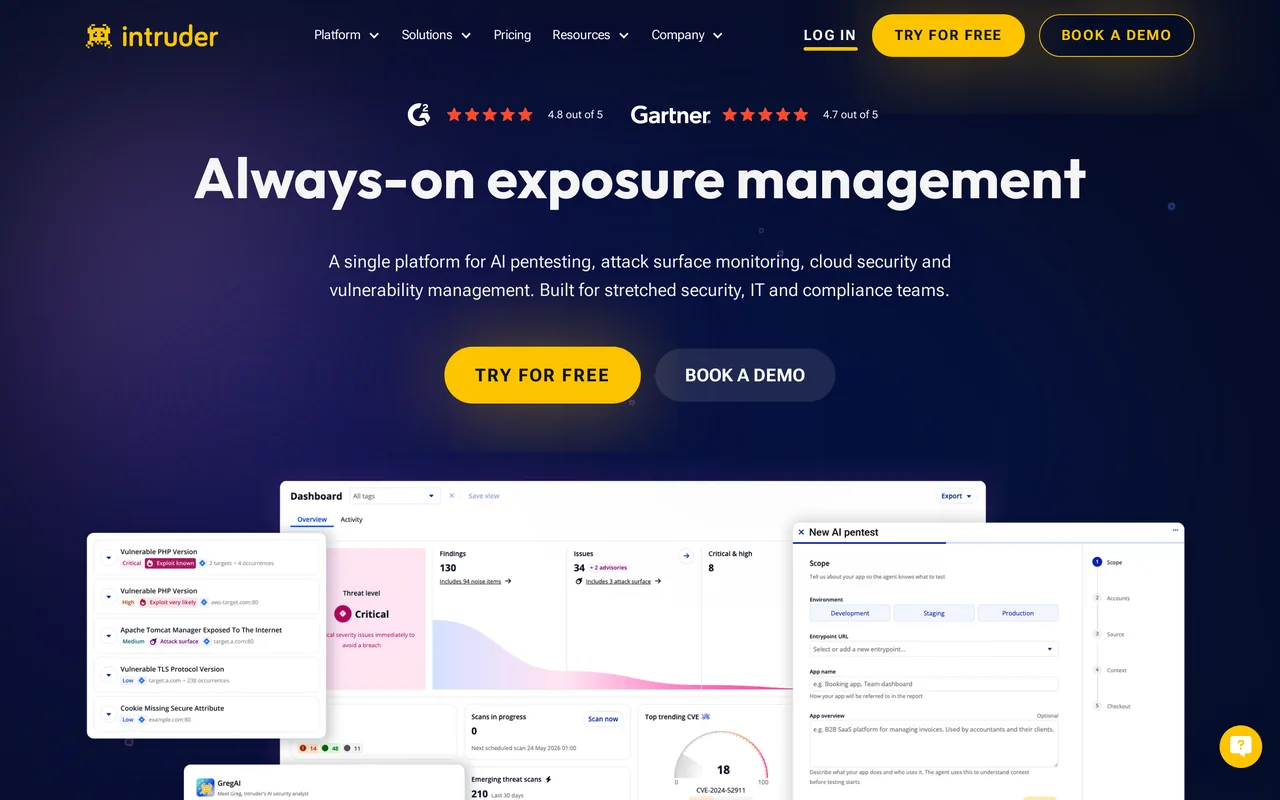
Intruder built its business on being the vulnerability management product a five-person security team can actually run, and that discipline shows: clean interface, sane defaults, continuous monitoring, and alerts when your attack surface changes rather than when a scan happens to run.
Its 2026 move into AI pentesting agents is what earns the listing. The pitch is pointed — automating work that has historically carried a five-figure manual price tag — and the per-test entry around $3,500 puts proper pentest-grade testing inside a budget that previously bought scanning alone. For the lean-team buyer, that is the most consequential price movement in the category this year.
The agents are newer and narrower than the AI-native specialists field, and the platform remains exposure-management-first. If you want the deepest autonomous attacker available, this is not it. If you want one tool that covers continuous VM, cloud posture and credible automated pentesting for a team that does not have a dedicated offensive function, it is extremely well judged.
"Unified, always-on exposure management for lean security teams. A single platform for vulnerability management, attack surface monitoring and cloud security." — intruder.io, October 2026
Strengths
Genuinely usable by a small team without a dedicated offensive security function
AI pentest agents at a per-test price that undercuts manual engagements by an order of magnitude
Continuous attack surface monitoring with change-triggered alerting
Watch out for
AI pentest capability is newer and shallower than the specialists
External and cloud focus; no internal network attack chaining
Exposure management first, pentesting second — the balance matters for your use case
Standout: Pentest-grade AI agents at a price that used to buy a scanner licence.
Automated exposure validationBest for: Automated network pentesting for MSPs and lean IT teams
Headquarters
Atlanta, Georgia, USA
Founded
2018
Ownership & funding
Acquired by Kaseya in 2023
Entry price
From ~$300/month; packages commonly from ~$2,999
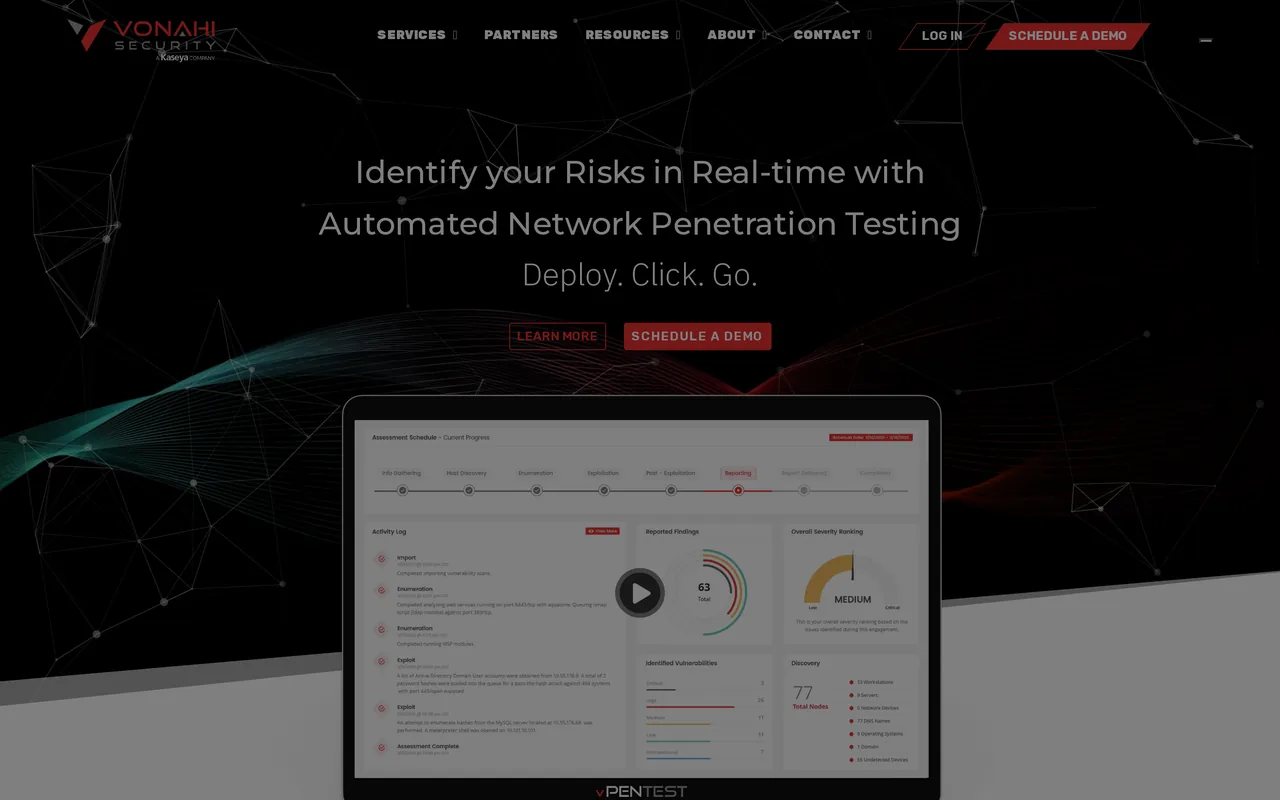
vPenTest is the most honest product in this guide about what it is: automated network pentesting, priced and packaged for managed service providers who need to deliver a defensible test to a hundred small clients without hiring a hundred testers. It does the internal and external network work — enumeration, credential attacks, relay, lateral movement — and produces a report an SMB client and their cyber insurer both accept.
The Kaseya acquisition in April 2023 gave it distribution into one of the largest MSP channels in the world, which is why it shows up in so many small-business security stacks. The monthly pricing model means a 50-site MSP can run monthly tests rather than annual ones, and monthly beats annual every time on a network that changes.
It is rules-driven, not autonomous in the frontier-model sense, and it has essentially no application-layer depth. Judge it against the alternative most of its customers actually have — which is no pentest at all, or one every eighteen months — and it looks very good indeed.
"Meet vPenTest, the automated network pentesting solution from Vonahi Security that's affordable, efficient, and built for MSPs & IT teams." — vonahi.io, October 2026
Strengths
Genuinely affordable network pentesting at monthly cadence, from ~$300/month
Purpose-built MSP multi-tenancy, white-labelling and scheduling
Reports that satisfy SMB compliance and cyber insurance requirements
Watch out for
Rules-driven automation, not agentic reasoning
Almost no web application or API testing depth
Now part of a large platform vendor — roadmap follows Kaseya's channel priorities
Standout: Monthly network pentests at a price an MSP can resell profitably.
AI-native autonomousBest for: Autonomous agents that find, fix and re-test inside the development loop
Headquarters
San Francisco, California, USA
Founded
2025
Ownership & funding
Seed stage; Y Combinator X25 cohort
Entry price
Startup-friendly subscription; quote-based
MindFort takes the one step past exploitation that almost nobody else takes: its agents propose the patch. The loop is find, fix, re-test, prove — which reframes autonomous pentesting from a reporting tool into something closer to a continuous remediation system that happens to start with an attack.
The founding team is credible for exactly this. Brandon Veiseh came from ProjectDiscovery and NetSPI — open-source offensive tooling and enterprise pentesting — and Akul Gupta red-teamed models at OpenAI and Anthropic. The framing of the product around hardening software against agentic attackers, rather than against a 2019 threat model, reflects where both of them have been looking.
It is a 2025-founded seed-stage company. Expect roadmap gaps, limited compliance scaffolding and a small support team. For a fast-moving engineering organisation that wants security testing inside the development loop rather than bolted on at the end, that trade is often worth making.
"Frontier security agents that continuously pen test your live products and services. Find exploitable vulnerabilities, ship the fix, and retest to prove it holds." — mindfort.ai, October 2026
Strengths
Closes the loop: finds the flaw, proposes the fix, re-tests to prove it holds
Founders from ProjectDiscovery, NetSPI and frontier-model red teams
Built for the SDLC, not for a quarterly report cycle
Watch out for
Earliest-stage company in this guide — seed funding and a small team
Thin compliance and attestation tooling
Application scope only
Standout: Agents that ship the patch, not just the finding.
Automated exposure validationBest for: Breach and attack simulation with attack path validation at enterprise scale
Headquarters
Sunnyvale, California, USA
Founded
2014
Ownership & funding
~$106M total
Entry price
Quote; enterprise pricing, commonly $60k–$150k/yr
SafeBreach has one of the largest curated attack playbooks in the industry, continuously updated against live threat intelligence, and it runs that library against your actual controls at scale. For a mature security operations function, the question "would we detect the campaign that hit our sector last Tuesday" has a same-day answer.
The addition of attack path validation on top of classic simulation moves it closer to the pentest end of the spectrum: not just "did this technique get blocked" but "does this chain of techniques reach something that matters". Combined with CTEM orchestration, it is a strong fit for organisations that have already built detection engineering capability and need to keep it honest.
It is an enterprise purchase with enterprise deployment effort, and it validates controls rather than discovering unknown attack surface. Mid-market teams will find both the price and the operational overhead hard to justify.
"SafeBreach provides the leading exposure validation platform, combining breach and attack simulation with attack path validation." — safebreach.com, October 2026
Strengths
Very large, continuously refreshed attack playbook tied to live threat intelligence
Attack path validation layered on top of classic simulation
Strong fit for mature detection engineering teams that need continuous honesty checks
Watch out for
Enterprise pricing and a real deployment project across the estate
Validates known behaviour against known controls — no discovery, no improvisation
Requires mature security operations to extract the value
Standout: Answers "would we have caught last week's campaign" by actually running it.
Automated exposure validationBest for: Lower-cost automated validation with zero-false-positive positioning
Headquarters
Santa Clara, California, USA
Founded
2020
Ownership & funding
~$3.1M disclosed
Entry price
Quote only; typically well below the enterprise AEV platforms
RidgeBot is an automated pentest robot that exploits rather than merely detects, and the company stakes its reputation on a zero-false-positive claim built on that distinction: if the exploit did not land, it is not reported. That is the right architectural instinct, and it puts RidgeBot ahead of any scanner that infers risk from a version banner.
It is also materially cheaper than the enterprise exposure validation platforms while covering comparable ground — internal and external network targets, continuous scheduling, multiple concurrent targets. For a mid-market team that wants exploit-validated findings without a six-figure commitment, it is a serious option that gets overlooked because the marketing budget is small.
The company is small and lightly funded, which shows up in integration breadth and support depth rather than in the engine. Run a proof of concept against a known-vulnerable target first and check the report format against what your auditor will accept.
"Ridge Security's RidgeBot security validation platform powers CTEM with offensive security testing. Prioritize real risks with zero false positives." — ridgesecurity.ai, October 2026
Strengths
Exploit-validated findings as the design principle, not an add-on
Substantially cheaper than enterprise AEV platforms for comparable network coverage
Handles many targets concurrently with continuous scheduling
Watch out for
Small, lightly funded company — check support terms carefully
Integration ecosystem is thin next to Pentera or Cymulate
"Zero false positives" is a marketing frame; verify it in a proof of concept
Standout: Exploit-validated results at a fraction of enterprise validation pricing.
Automated scanning & ASMBest for: Self-service offensive toolkit now carrying an autonomous AI tier
Headquarters
Bucharest, Romania
Founded
2013
Ownership & funding
Bootstrapped
Entry price
From ~$95/month, published
Pentest-Tools.com has been the pragmatic consultant's toolkit for over a decade: hosted versions of the scanners and utilities you would otherwise maintain yourself, with scheduling, reporting and an API bolted on. In 2026 it added an autonomous AI pentesting tier, which is a notable signal — when the bootstrapped, revenue-disciplined vendor adds agents, the capability has crossed from novelty into expectation.
The value is accessibility. From roughly $95 a month you get a serious toolkit with published pricing, no sales process, and output that a small consultancy can white-label into client reports. For internal teams it covers the recurring external scanning work that does not justify an enterprise platform.
Set expectations correctly: the autonomous tier is newer and narrower than what the venture-funded specialists field, and the core product remains validation-oriented scanning rather than deep attack-path reasoning. For the price, that is not a criticism.
"Vulnerability scanning and validation, autonomous AI pentesting, and human-led offensive security testing in one place. For web, network, and cloud." — pentest-tools.com, October 2026
Strengths
Published pricing from ~$95/month with no sales process
Broad, well-maintained toolkit covering web, network and cloud in one console
Reporting that small consultancies can white-label directly
Watch out for
Autonomous tier is early relative to the AI-native specialists
Scanning-and-validation depth rather than deep attack-path reasoning
Small team; enterprise support expectations will not be met
Standout: A decade-old bootstrapped toolkit that shipped autonomous AI without raising a round.
Automated exposure validationBest for: MITRE ATT&CK-aligned control validation and purple teaming
Headquarters
Santa Clara, California, USA
Founded
2013
Ownership & funding
~$95M total
Entry price
Quote; Flex tier lowers the entry point below the classic enterprise deployment
AttackIQ is the most rigorously MITRE ATT&CK-native platform in this guide, and for organisations that have standardised on ATT&CK as their coverage language, that alignment removes an entire translation layer. Results map directly onto the matrix your detection engineers already use to plan work.
Its research and academy output has genuinely shaped how the industry talks about adversary emulation, and the purple team workflow is first-class: run the emulation, watch what the SOC sees, tune, re-run, measure. The Flex tier made that accessible to organisations that could not justify a full enterprise deployment.
Two notes. It validates controls against known adversary behaviour — it is not an attacker that discovers and improvises. And the platform rewards investment: teams that treat it as a quarterly compliance exercise get a fraction of the value that teams running weekly purple exercises extract. Worth adding that AttackIQ's site blocks automated capture, which is why this entry carries no homepage screenshot.
AttackIQ describes its platform as an Adversarial Exposure Validation platform combining adversary emulation, security control validation and MITRE ATT&CK-based assessment. (Homepage declined automated capture for this guide.)
Strengths
Deepest MITRE ATT&CK alignment in the category — results map straight onto your coverage matrix
Excellent purple team workflow and widely respected research output
Flex tier lowers the entry barrier below a full enterprise deployment
Watch out for
Known-behaviour emulation, not autonomous discovery or improvisation
Value scales with team maturity; a quarterly tick-box usage pattern wastes it
Enterprise deployment effort across a distributed estate
Standout: The purple team platform detection engineers actually ask for by name.
Automated scanning & ASMBest for: Discovering and validating exposures across a sprawling, acquisitive estate
Headquarters
Palo Alto, California, USA
Founded
2017
Ownership & funding
~$153M total
Entry price
Quote; enterprise pricing scaled by attack surface
CyCognito solves attribution at a scale most organisations underestimate. For a conglomerate with forty acquisitions, twelve cloud tenants and a dozen forgotten brand domains, simply establishing what belongs to you is the hard problem — and CyCognito's graph-based reconnaissance, which maps relationships between organisations, domains and infrastructure, is the best commercial answer to it.
It then tests what it finds, automatically, and validates the exposures so that the output is prioritised by demonstrated risk rather than by CVSS alone. That combination — discovery you could not do yourself, plus validation that filters the noise — is why it keeps winning large, messy enterprise estates.
The testing depth is good, not elite. CyCognito will tell you an exposed admin interface is exploitable; it will not spend six hours chaining its way into your production database the way the AI-native engines will. Pair accordingly, and expect enterprise pricing — this is not a mid-market product.
"CyCognito continuously identifies and validates critical exposures to help you act fast where it matters most." — cycognito.com, October 2026
Strengths
Best-in-class attribution: finds the assets you own and did not know about
Fully agentless, so deployment is genuinely fast across a messy estate
Validation filters discovered exposures down to what is demonstrably reachable
Watch out for
Exploitation depth is moderate relative to the autonomous specialists
Enterprise pricing — hard to justify below a few thousand external assets
External perspective only
Standout: Maps the attack surface your asset inventory has never heard of.
Automated scanning & ASMBest for: Hacker-sourced payloads turned into automated testing at machine speed
Headquarters
Stockholm, Sweden & Boston, USA
Founded
2013
Ownership & funding
~$42M total
Entry price
Published tiers; roughly €0–€15,000/yr depending on scope
Detectify's model is distinctive and genuinely clever: a private network of ethical hackers submits working exploit modules, Detectify productionises them, and every customer gets the technique within days. You are not buying an AI that reasons — you are buying a pipeline that turns fresh human research into automated tests faster than anyone else.
In practice that means Detectify is often first to flag a newly weaponised technique against your estate, because a real researcher built the payload and it shipped to the whole customer base. With 2,100-plus teams and published pricing that starts near zero for small scopes, it is also one of the most accessible entries here.
The limitation follows from the model. Detectify tests for things hackers have already submitted; it does not improvise against your specific application logic. It is a superb breadth layer and a poor substitute for depth.
"Find what's exposed and fix what matters, before attackers do. Real-world hacker research at machine speed. Trusted by 2,100+ teams." — detectify.com, October 2026
Strengths
Crowdsourced exploit modules reach every customer within days of submission
Excellent at catching newly weaponised techniques across a broad surface
Published, accessible pricing with a genuinely usable low tier
Watch out for
Payload-library driven — no reasoning against your specific business logic
External application surface only
Not a substitute for a depth-oriented pentest on a critical application
Standout: Fresh human exploit research productionised for every customer within days.
Automated exposure validationBest for: Attack path modelling to the assets that would actually hurt
Headquarters
Herzliya, Israel
Founded
2016
Ownership & funding
~$49M raised before acquisition by Schwarz Group
Entry price
Quote; enterprise pricing
XM Cyber is the best answer in this guide to the prioritisation problem. It models every path from any foothold to your defined critical assets, then identifies the choke points — the handful of fixes that sever the largest number of paths. For a team drowning in 40,000 open findings, that reframing is worth more than another thousand findings.
Founded by Israeli intelligence alumni and acquired by Germany's Schwarz Group in 2021, it carries the kind of balance-sheet stability that matters for a ten-year platform decision. Coverage spans hybrid cloud and on-premises in one graph, which is where most attack path tools quietly give up.
It is modelling-led rather than exploitation-led. XM Cyber tells you a path exists with high confidence; it does not hand you the extracted database to prove it. If your stakeholders need a demonstrated breach to release remediation budget, pair it with an engine that exploits.
"Illuminate and disrupt the attack paths leading to your critical assets, in the cloud or on-premises." — xmcyber.com, October 2026
Strengths
Choke point analysis turns an unmanageable finding list into a short, ranked fix plan
Single attack graph across hybrid cloud and on-premises
Corporate-owned and financially stable for long-horizon platform decisions
Watch out for
Models and simulates paths rather than exploiting them end to end
Enterprise pricing and deployment effort
Needs an accurate critical-asset definition to be useful — garbage in, garbage out
Standout: Finds the five fixes that break ten thousand attack paths.
Attack path modelling to the assets that would actually hurt
6
6
6
7
$$$$$100k+/yr
2016
$49M
Herzliya, Israel
Showing 30 of 30platforms. Scores are 1–10 on this guide’s published criteria. Funding figures are publicly reported totals as of October 2026; “—” means bootstrapped, publicly traded, or not disclosed.
Figure 4 — capability matrix
Every platform against every criterion, in one picture
WeakStrong
Darker is stronger, on the same 1–10 scale used by the ranking tool. Read it vertically to find who leads a column you care about; read it horizontally to see the shape of a vendor — a solid dark row means a broad platform, a dark block on the left with a pale right means a focused attacker. Hover any cell for the exact score.
Head-to-head comparison tool
Put any three on the same bench
Click up to three platforms. Pick a fourth and the oldest selection drops off.
On-prem appliance or SaaS; agent and agentless modes
Entry price
Quote only; buyer data puts the median contract near $18.6k/yr, large estates near $60k
Enterprise quote only
Typically ~$35k/yr entry, commonly $50k–$120k/yr by asset count and module
Autonomy depth
10
10
8
Exploit proof quality
10
10
9
Attack depth in scope
10
10
9
Continuous cadence
9
9
10
Coverage breadth
7
3
10
Workflow & integrations
9
7
9
Price accessibility
5
2
2
Human validation
5
5
4
Track record & scale
9
7
10
Compliance reporting
8
6
10
Strengths
Genuinely unattended internal network attack chaining — no scripts to maintain, no scenario library to curate
Proof of impact is concrete: the credential, the host, the data, the exact path taken
Re-run the identical attack after remediation in one click to prove the fix held
The strongest public, adversarial benchmark in the category — a top-ranked HackerOne result against human researchers
Findings arrive as reproducible proof-of-concept exploits, not inferred risk
Strategic backing from Accenture, NVIDIA and Samsung points to long-term staying power
Broadest single-vendor coverage here: internal, external, cloud and credential exposure in one platform
Built for continuous production use with a bounded blast radius — the safety engineering is excellent
Reporting that survives contact with auditors and boards without rewriting
Watch out for
Web application and API testing is the shallow end of the platform relative to its network work
Per-asset pricing scales fast across large or ephemeral estates — model your real asset count before signing
No published price list; expect a procurement cycle rather than a credit card
Application and API scope only — no internal network, Active Directory or identity attack paths
Enterprise pricing with no published entry point; not a mid-market purchase
Young company relative to the estate sizes it now sells into
Technique-library driven rather than genuinely improvisational — it stops at the edge of what was encoded
One of the most expensive entries in the guide, with modules priced separately
Application-layer business logic is not its strong suit
Twelve more worth knowing about
These did not make the thirty, usually because they solve an adjacent problem rather than a worse version of the same one. Several are excellent inside their scope.
Company
What it does
Headquarters
Why it is not in the thirty
Pikered (ZAIUX Evo)
Agentless automated breach & attack simulation
Milan, Italy
Named a Representative Vendor in Gartner's 2026 AEV market guide; strong NIS2 and DORA reporting, but Europe-centric distribution.
Mindgard
Runtime AI and LLM red teaming
London, UK
Excellent at attacking models and agentic applications — a different attack surface from the one this guide ranks.
ZeroPath
Source-code-aware AI vulnerability discovery
San Francisco, USA
Finds flaws in code before deployment rather than exploiting running systems; complements rather than competes.
Edgescan
Risk-based vulnerability management with validation
Dublin, Ireland
Human-validated scanning with a long track record; automation depth below the ranked cohort.
Probely
Developer-first DAST for web apps and APIs
Lisbon, Portugal
Clean API-first scanner with great CI/CD ergonomics, but scanning rather than autonomous exploitation.
Beagle Security
Automated web and API pentesting
Kerala, India & Delaware, USA
Very accessible pricing and decent automation; shallower attack chaining than the ranked entries.
Strobes Security
Unified CTEM and pentest orchestration
Dallas, USA
Strong aggregation and workflow layer; the testing engines are largely partnered rather than owned.
Rootshell Security
Vulnerability orchestration with pentest delivery
Reading, UK
Good remediation workflow; automation is orchestration rather than autonomous attack.
SCYTHE
Adversary emulation and purple teaming
Arlington, USA
Powerful emulation platform for mature teams that build their own campaigns; requires real operator skill.
IONIX
Attack surface management with exploit validation
Tel Aviv, Israel
Strong on digital supply chain discovery; validation depth below the dedicated AEV platforms.
Skyhawk Security
Cloud threat detection with exposure validation
Tel Aviv, Israel
Mentioned in the 2026 Gartner AEV market guide; cloud-runtime focused rather than pentest-focused.
Equixly
Continuous API penetration testing
Rome, Italy
Focused API testing with good CI/CD integration; narrow scope by design.
Figure 2 — capital
Disclosed funding: who is financed to still be here in 2030
Publicly reported cumulative funding, in US dollars, as of October 2026. Invicti's figure is a private-equity growth investment rather than venture rounds, and NetSPI's reflects KKR's backing — both are structurally different from a Series E. Bootstrapped vendors (Pentest-Tools.com, Pentestas), publicly traded ones (Rapid7) and corporate-owned ones (Vonahi under Kaseya) are excluded because the number would not mean the same thing. Capital is not capability — but in a category this young, it is a decent proxy for whether your vendor survives your contract term.
Figure 3 — cost
What these platforms actually cost, on a logarithmic scale
Realistic annual spend bands, built from published price lists where they exist and from buyer-reported contract data where they do not. Note the shape: a 200× spread between the cheapest published entry point and a large enterprise exposure validation contract, for products that all describe themselves as automated pentesting. Per-test and promotional prices are annualised to a plausible programme. Treat these as negotiation anchors, not quotes.
What automated and autonomous pentesting costs in 2026
The single most useful thing to understand about pricing in this category is that the number matters far less than the unit. Two vendors quoting “$40,000” can differ by a factor of three once you apply your real asset count, because one charges per asset, one per application, one per credit-hour and one per environment. Model your own estate against each unit before you compare quotes.
Pricing unit
Who uses it
Where it is cheap
Where it bites
Per asset / IP
Horizon3.ai, Pentera
Small, stable estates
Ephemeral cloud infrastructure, where asset counts balloon
Per application / target
Astra Security, Terra Security
One or two flagship products
A portfolio of twenty microservices
Per credit-hour
Cobalt
Predictable, well-scoped engagements
Unknown scope — credit estimation is where buyers overspend
Per environment / subscription
Picus, Cymulate, SafeBreach
Large single environments
Multiple business units needing separate tenancies
Flat monthly SaaS
Pentestas, Pentest-Tools.com, Intruder, vPenTest
Teams that want a predictable line item
Very large estates hitting tier ceilings
Per engagement
NetSPI, Bugcrowd, HackerOne
Annual compliance testing
Anything needing continuous coverage
Ask every vendor to quote your actual estate, not a reference architecture. The variance between units on the same environment routinely exceeds the variance between vendors.
Budget band
What it buys in 2026
Representative vendors
Under $10k/yr
Self-serve continuous scanning plus genuine automated exploitation on a handful of targets. Compliance-grade reporting included.
Four questions get most buyers to the right shortlist. The failure mode this prevents is the common one: buying a brilliant internal network attacker to test a SaaS product, or a world-class application agent to satisfy an internal segmentation requirement.
An eight-point framework for evaluating any platform
Score each candidate 1–5. A total above 32 is a strong fit; 24–32 is workable with compensating controls; below 20 means you are buying a vulnerability scanner with better marketing.
#
What to score
A 5 looks like
A 1 looks like
1
Evidence quality
Every finding ships with the request, the response and the extracted data
A CVE number, a CVSS score and a confidence percentage
2
Autonomy under surprise
Demonstrably improvises past an unanticipated application behaviour
Stops and reports the technique as inconclusive
3
False positive discipline
Exploitation-gated reporting, or an explicit validation layer
"Our AI is highly accurate"
4
Production safety
Named hard-blocked action classes, a kill switch, candid incident history
"We have never had an incident"
5
Scope fit
Deep in exactly the surface where your risk lives
Broad coverage, shallow everywhere
6
Cadence economics
Testing on every deploy costs the same as testing quarterly
Each additional run is a new purchase order
7
Workflow integration
Findings land in your tracker with reproduction steps, automatically
A PDF arrives by email
8
Vendor durability
Funded or profitable enough to outlive your contract term
Seed stage, three-year term, no portability clause
Fifteen questions to ask before you sign
1Show me a real finding from a current customer, redacted — the request you sent, the response you received, and the data you extracted.
2When your engine encounters an application behaviour it has never seen, what happens next? Walk me through a specific example.
3What classes of action are hard-blocked in the engine, at the code level, regardless of configuration?
4Describe your most recent production incident at a customer and what changed in the product afterwards.
5How is a finding validated before it reaches me — exploitation, a second model, a human, or a confidence score?
6What does testing cost if I run it on every deploy rather than once a quarter?
7What exactly is the pricing unit, and what happens to my bill when my asset count doubles?
8Does a retest after remediation cost extra?
9Which compliance frameworks do you issue attestation letters for, and can I see a redacted example?
10How do findings reach my issue tracker, and do they include reproduction steps a developer can run?
11What happens to my data — findings, credentials, extracted evidence — at contract termination?
12Who owns the company, and have there been ownership changes in the last twenty-four months?
13Can I speak to a customer in my industry, at my scale, who has been live for more than a year?
14What does your platform explicitly not test, and which vendor do you recommend alongside it?
15If I run a proof of concept against an application you have never seen, will you commit to the result in writing?
The question that does the most work
Question 14 — “what do you explicitly not test, and who do you recommend alongside you?” — is the single best signal in the list. Vendors who understand their own scope answer it immediately and name a competitor without flinching. Vendors who claim to cover everything are telling you they have never been measured against anything.
How to run a proof of concept that actually tells you something
Most proofs of concept in this category are theatre: the vendor points the platform at a deliberately vulnerable demo application, it finds the deliberately placed vulnerabilities, everyone nods. Here is a protocol that produces a real answer in about two weeks.
Pick a target you already have ground truth for. The best candidate is an application that was manually pentested in the last twelve months, because you have a human-produced list of what is actually there. Second best is an internal network segment you know well.
Run two or three candidates against the same target, in the same window. Sequential evaluations are worthless — the environment changes, your attention changes, and you end up comparing memories. Run them in parallel and compare outputs side by side.
Count four numbers. True positives found that the human report also had. True positives the human missed — this is where autonomous engines earn their fee, and a good one will find two or three. False positives. And triage time: how many hours did your team spend establishing which category each finding belonged in? That last number is the real cost of the product, and it is almost never on the quote.
Then change something and re-run. Fix one finding, deploy, trigger a re-test, and measure how long it takes for the platform to confirm the fix. Continuous testing that cannot verify remediation quickly is just a scanner on a schedule.
Where this goes next
Three things look likely over the next eighteen months, and they should shape a contract you sign today.
The categories finish collapsing. Gartner already merged breach and attack simulation with automated pentesting. The next merge is between exposure validation and autonomous pentesting, because customers do not want two tools that both claim to prove exploitability. Expect the exposure validation incumbents to acquire agentic capability rather than build it — Invicti and NetSPI have already moved, and both did it by shipping agents on top of an existing engine.
Agents start attacking agents. The attack surface everyone is building right now — LLM features, MCP servers, autonomous agents with tool access and production credentials — is barely covered by the thirty platforms here. A handful have started: Mindgard on model red teaming, HackerOne on AI red teaming, and a small number of platforms including ours on MCP server scanning. By 2027 this will be a standard line item rather than a differentiator.
Human testing gets more expensive and more valuable. As machines absorb breadth, human engagements will concentrate on business logic, chained physical and social attacks, and the creative work machines cannot yet reach. Day rates for genuinely good operators will go up, not down, and the NetSPI–Synack merger is a bet on exactly that.
The short version
If you want one recommendation per situation, here is the compressed form of everything above.
If you are…
Start with
Because
A B2B SaaS company testing your own product
XBOW, Terra Security, RunSybil, Pentestas
Application and API depth is the whole job; network coverage is irrelevant to you
An enterprise with a large internal network
Horizon3.ai, Pentera
Unattended lateral movement and Active Directory abuse is where your risk actually is
Pentestas runs as an AI penetration testing system rather than a scanner with a chatbot attached: the exploitation engine drives several frontier models in parallel, because they fail differently and a chain one model abandons another completes. Our penetration testing with Claude pipeline handles the long reasoning chains — authenticated crawling, access-control logic, multi-step API abuse — while penetration testing with DeepSeek covers high-volume payload iteration at a fraction of the cost per request. Every discovery passes a central authenticity oracle before it is allowed to become a finding, which is why a 200 OK never ships as a breach.
We sell it as pentesting as a service with published pricing from $79 a month, because the B2B SaaS pentest market has been held hostage by discovery calls for long enough. If that approach to penetration testing with AI is the shape of what you need, the links below go straight to the product. If one of the other twenty-nine platforms in this guide fits you better, that is a perfectly good outcome — and the ranking tool above exists precisely so you can establish which.
Frequently asked questions
+What is the difference between an automated pentest platform and an autonomous one?
The difference is who decides the next move. An automated pentest platform executes a sequence of techniques that engineers encoded in advance: it runs a known attack library against a scope a human defined, adapts within those rules, and stops when it reaches the edge of them. An autonomous pentest platform replaces that rule engine with an AI agent that scopes itself from a signal, reasons about what it is seeing in real time, and improvises past a failed step the way a human attacker would.
In practice the line is blurry and getting blurrier. Pentera and Picus are automated platforms with AI layered on; Horizon3.ai, XBOW and Terra Security are agent-led. Most buyers care less about the taxonomy than about one measurable thing: when the engine hits something nobody anticipated, does it stop, or does it keep going?
+Can an automated or autonomous pentest replace a human pentest for compliance?
For most frameworks, yes — with a caveat. SOC 2, ISO 27001, PCI DSS, HIPAA and the great majority of customer security questionnaires require evidence of regular penetration testing by a competent party with a defined methodology, not evidence that a human typed the commands. Platforms in this guide produce attestation letters and evidence packages that auditors accept routinely.
The exceptions are the regimes that specify threat-led or intelligence-led testing by qualified individuals: DORA TLPT, CBEST, TIBER-EU and some FedRAMP scenarios. Those name human-led red teaming explicitly. The pattern that works is continuous automated testing year-round, with a human-led engagement at whatever cadence your specific regulator demands.
+How much do automated and autonomous pentest platforms cost in 2026?
The spread is roughly 200 to 1. Published self-serve entry points start under $2,000 a year — Astra Security at $1,999 per target, Pentestas from $79 a month, Pentest-Tools.com from about $95 a month. Mid-market platforms land between $15,000 and $50,000 a year: Cobalt credits, Sprocket programmes, FireCompass, Ridge Security. Enterprise exposure validation platforms — Pentera, SafeBreach, XM Cyber, CyCognito — commonly run $50,000 to $150,000 and up.
Horizon3.ai sits in between, with buyer-reported median contracts near $18,600 a year and larger estates near $60,000, priced per asset. The single biggest driver of cost variance is not capability, it is the pricing unit: per asset, per application, per credit or per environment. Model your real numbers against each unit before comparing quotes, because the same estate can differ by 3× between two vendors quoting the same capability.
+Which autonomous pentest company is the best?
There is no single best, which is why this guide ships a ranking tool instead of a verdict. On the balanced weighting, Horizon3.ai leads because NodeZero combines genuine unattended autonomy with the deepest internal network attack chaining and a very large deployed base. Weight raw autonomy and exploit proof above everything else and XBOW moves to second on the strength of a public leaderboard result against human researchers. Weight compliance and human validation and Synack leads. Weight entry price and the cheapest published platform wins.
The question that actually resolves it is narrower than "who is best": what are you testing, how often do you need it tested, who has to believe the report, and what can you spend? Answer those four and the shortlist usually collapses to two or three names.
+Are autonomous pentest platforms safe to run against production?
The mature ones are, and they are engineered for it specifically — but you should verify rather than assume. Horizon3.ai, Pentera and Picus all invest heavily in bounding the blast radius: no destructive payloads, no denial of service, no data modification, with explicit safety rails around what an exploit is permitted to do once it lands.
Ask three questions of any vendor before pointing it at production. What specific classes of action are hard-blocked in the engine? Is there a kill switch and how fast does it take effect? And what is the actual incident history — not "has anything ever gone wrong", but "describe the last production incident and what changed afterwards". A vendor that cannot answer the third question candidly has either not been running long enough or is not being straight with you.
+Do these platforms produce false positives?
All of them do, and any vendor claiming zero is describing a marketing position rather than an engineering one. What differs enormously is the mechanism for controlling it. The strongest approach is exploitation-gated reporting: nothing is reported unless the engine actually exploited it and captured the evidence, which is how Invicti's proof-based scanning, RidgeBot and Pentestas all work. The next strongest is a validation layer — a second AI in Hadrian's case, a human reviewer in Terra's, BreachLock's and Synack's.
The weakest is a confidence score attached to an inference. If a platform reports a vulnerability because a version banner matched a CVE, you are back to reading scanner output. Test this directly in your evaluation: run the candidate against a target where you already know the ground truth from a recent manual pentest, and count.
+How often should an automated pentest platform run?
Match the cadence to the rate of change, not to the audit calendar. A SaaS product deploying several times a day should test on every meaningful release — that is the entire economic argument for automation. A corporate network changes more slowly, so weekly or monthly internal testing is usually proportionate, with an immediate run after any significant infrastructure change, merger or acquisition.
The anti-pattern is buying a continuous platform and running it quarterly because that is what the old consulting contract did. You are then paying subscription prices for point-in-time coverage and getting the worst of both models.
+What should I ask a vendor in a proof of concept?
Insist on testing a target where you already know the answer. The ideal is an application you had manually pentested in the last twelve months: run the platform, then compare its output against the human report line by line. Count what it found, what it missed, what it invented and how long triage took.
Then ask for one real finding from an existing customer, redacted — with the request that was sent, the response that came back and the data that was extracted. Vendors that exploit will show you this immediately. Vendors that infer will send you a sample PDF. That single request separates the field faster than any feature matrix, including this one.
+Is the autonomous pentest market consolidating?
Visibly. Kaseya acquired Vonahi Security in 2023 and pushed automated network pentesting into the managed service provider channel. NetSPI and Synack agreed to merge in September 2026 under KKR, creating an 800-person, $200M-plus offensive security business. Schwarz Group owns XM Cyber, Summit Partners owns Invicti, and Accenture, NVIDIA and Samsung have all taken strategic positions in XBOW.
The practical consequence for buyers is contract risk. If you are signing a three-year term with a venture-backed startup in this category, negotiate for data portability, a defined exit process and roadmap commitments in writing. Some of the thirty names in this guide will have different owners by 2028.
+Do I still need a human pentester if I run an autonomous platform?
For most organisations, yes — but far less often and for different work. Machines are now better than most humans at breadth, consistency, regression and the long tail of known technique classes, and they never get bored on hour six of enumeration. Humans remain better at business logic that requires understanding what the application is for, at chained social and technical attacks, and at the creative leap that produces a finding nobody has a name for yet.
The configuration most mature teams land on is continuous machine testing as the baseline, with a focused human engagement once or twice a year aimed specifically at what the machine cannot reason about. That is also the architecture the market has converged on: Synack, BreachLock, Terra Security, Sprocket and NetSPI all ship it as a single product now.
See what an autonomous pentest actually returns
Run Pentestas against a target you already know. You will get the findings with the request we sent, the response we got back and the data we extracted — the same evidence standard this guide asks every vendor to meet.
Founder of Pentestas. Author of two information security books, cybersecurity speaker at the largest security conferences in Asia and a United Nations conference panellist. Former Microsoft security consulting team member and external cybersecurity consultant at the Emirates Nuclear Energy Corporation.